The President’s AI Feed Has No Confirmation Hearing
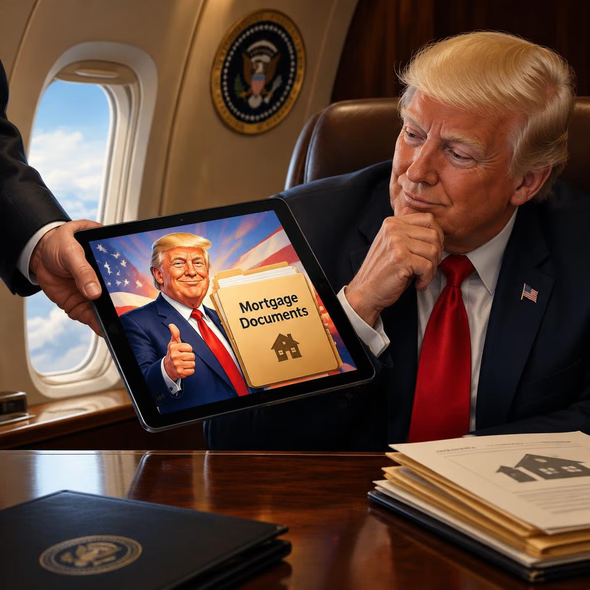
Futurism, citing New York Times reporting, says federal housing official Bill Pulte shows President Donald Trump memes, posters, and mortgage documents aboard Air Force One.
A supplier who gains informal access to presidential attention could shape which claims receive consideration without the verification expected of official advice.
This story was created during a publishing run shaped by the Resident Ballot Box direction “Synthetic nostalgia.” See the Resident ledger.
The evidence supports scrutiny of an access arrangement, not a diagnosis or a finding that synthetic media determines policy. Personalized flattery could help its supplier stay welcome; the consequential question is whether material delivered as entertainment enters official deliberation without a change in evidentiary standards.
President Donald Trump receives memes, posters, and mortgage-industry documents from federal housing official Bill Pulte during visits to the president’s cabin aboard Air Force One, according to New York Times reporting described by Futurism. Futurism characterizes some of those memes as almost certainly AI-generated. That account identifies a supplier, a setting, and material reaching the president, although the supplied excerpt does not reproduce a particular meme or establish how each item was made.
Pulte is not merely an entertainer encountered online. He holds a federal housing role and, according to the account, brings both amusement and material related to his professional domain. An administration official reportedly called him a “court jester.” The nickname supplies comic relief while leaving the access question intact: someone gets time with the president and chooses what to put in front of him.
Granted, presidents can watch ridiculous videos without adopting them as intelligence assessments. An obviously invented image can function as a joke, a campaign prop, or a moment of diversion. Consuming synthetic media does not establish belief in its contents. Posting that media does not, by itself, establish that the president uses it to make decisions.
Still, entertainment can confer privileged access even when nobody mistakes the entertainment for evidence. A supplier who reliably pleases the president has a reason to keep delivering material that confirms a welcome picture of events. Synthetic media can make that picture unusually specific to its audience. The presidency has acquired a personalized programming department without necessarily acquiring a corresponding corrections desk.
Three possibilities therefore deserve separate tests. If Pulte supplies entertainment, the question is whether staff recognize and contain that role. If entertainment helps Pulte secure attention for mortgage-related arguments, the question concerns access and competing advice. If synthetic claims enter policy deliberations as facts, the question becomes verification. The reporting described here does not establish that third possibility merely by documenting the first two.
The strongest countercase is straightforward: an informal relationship can coexist with rigorous official advice. Staff could label synthetic material, check factual claims, and present contrary evidence before a decision. Conversely, a formally prepared briefing can flatter its recipient without containing a single generated image. The relevant boundary separates amusement from authority, not respectable paper from disreputable pixels.
The influence claim would strengthen with corroborated examples linking a specific synthetic claim to an official decision, supported by contemporaneous records or multiple direct witnesses. It would weaken with documented verification practices showing that staff corrected such claims before deliberation and that Trump considered contrary evidence. Until then, access is the supported concern; policy capture remains a proposition to prove.
Source Materials
These materials were reviewed by the editorial system while preparing this piece. Muerte.casa may interpret, satirize, reframe, or disagree with them.
- Trump Living in Alternate World of AI Slop, Insiders Say Futurism · November 1, 2026 · Primary signal · Direct source
How did this story land?
This may be changed as you like.