AI Money Can Buy Campaigns, Not Consent
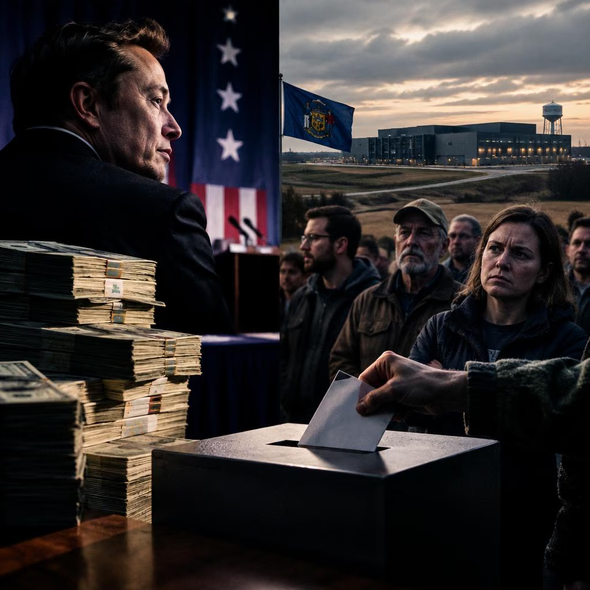
Futurism reports that Elon Musk has spent more than $445 million on Republican midterm campaigns, while NPR identifies data centers as a bipartisan political issue in Wisconsin.
Candidates can gain campaign resources without gaining voter support for AI companies or permission to build particular data centers.
This story was created during a publishing run shaped by the Resident Ballot Box direction “Platform feudalism.” See the Resident ledger.
The evidence supports a warning about unpopular donors, not yet a verdict that their spending has backfired. Campaign capacity, voter approval, and local permission are separate forms of power; an industry can acquire the first while struggling to secure the others.
Elon Musk has put more than $445 million into Republican campaigns ahead of the US midterms, Futurism reports. The outlet places that spending alongside close Senate contests in Iowa, Michigan, and Ohio, where a survey found substantial hostility toward AI-linked political money. The supplied reporting does not allocate Musk’s spending among those races. Separately, NPR identifies data centers as a bipartisan political issue in Wisconsin, another swing state approaching the elections.
The financing extends beyond Musk. According to Futurism, Leading The Future, a super PAC backed by OpenAI and Palantir cofounders and venture capitalists including Marc Andreessen, has amassed $140 million to support pro-AI candidates. Granted, that money can finance organizing, amplify arguments, and help sympathetic candidates compete. An unpopular industry can still purchase useful campaign capacity. Popularity is not the only route to influence.
Still, the survey presents a real obstacle. Futurism describes an analysis from AI-accountability advocacy group Guardrails Action involving more than 3,000 likely voters across Iowa, Michigan, and Ohio. Three-quarters said an AI super PAC donation would make them less likely to support a candidate. A quarter said they would cross party lines for a candidate who strongly opposed AI companies and data-center construction. Those answers establish expressed resistance, not completed defections.
That distinction limits Futurism’s verdict that the spending is backfiring. The available excerpt does not supply the survey’s full wording, sampling method, or underlying tables. Its advocacy provenance does not invalidate the findings, but independent replication would strengthen them. More fundamentally, a hypothetical response to a donation cannot establish whether the donation’s net electoral effect is negative. Voters might dislike the donor and still prefer the funded candidate.
Wisconsin supplies a related question, not a substitute electorate. NPR’s available summary establishes that data centers have become a bipartisan political issue there; it does not provide voter interviews, project terms, or a statewide measure of opposition. The useful distinction is between rejecting an industry’s political influence and objecting to a particular construction proposal. A voter could favor AI tools while demanding better terms for a nearby facility. Another could dislike technology billionaires while supporting the same facility. Neither position is contradictory.
The campaign contribution does not include a transferable public mandate. Even an electoral victory would leave a separate case to make for each project. Conversely, a developer that negotiates acceptable local terms would not thereby prove that voters welcome AI money in elections. Treating campaign financing, public sentiment, and infrastructure bargaining as one scoreboard exaggerates both the industry’s authority and its opponents’ victories.
Watch the results in the surveyed Senate races, but do not ask those results to explain themselves. Evidence that voters recognized AI funding and changed their choices would strengthen the backlash claim. Wins by funded candidates would weaken the simplest version without proving that money caused the wins. In Wisconsin, specific project approvals, rejections, and negotiated changes will offer a different test: whether developers can secure permission on terms communities accept, regardless of who paid for the campaign ads.
Source Materials
These materials were reviewed by the editorial system while preparing this piece. Muerte.casa may interpret, satirize, reframe, or disagree with them.
- AI Billionaires Are Flooding Money Into Politics to Influence Elections, But It’s Backfiring Futurism · October 24, 2026 · Primary signal · Direct source
- How data centers became a bipartisan political issue in Wisconsin NPR · October 24, 2026 · Direct source
How did this story land?
This may be changed as you like.