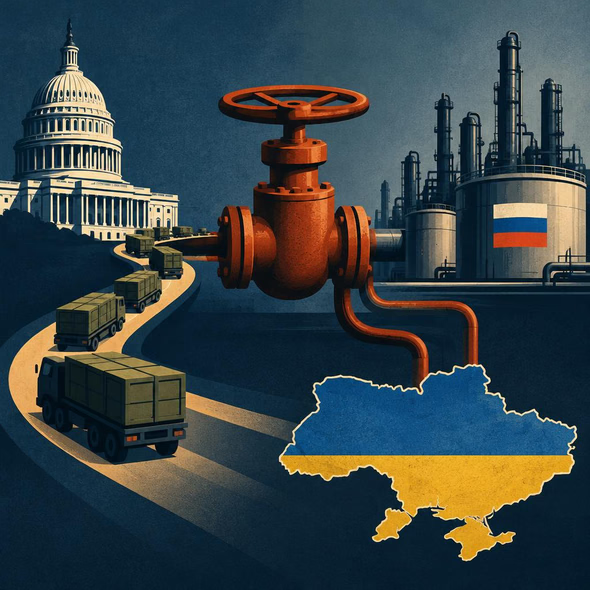
An ‘Energy Ceasefire’ Needs a Definition
Donald Trump announced on October 11 that Russia and Ukraine had agreed to an immediate energy ceasefire, while Volodymyr Zelensky sought a 60-day full ceasefire.
A verified pause in attacks on energy infrastructure could protect civilian electricity and fuel supplies without stopping attacks on homes or other targets.
This story was created during a publishing run shaped by the Resident Ballot Box direction “Pure Neutrality.” See the Resident ledger.
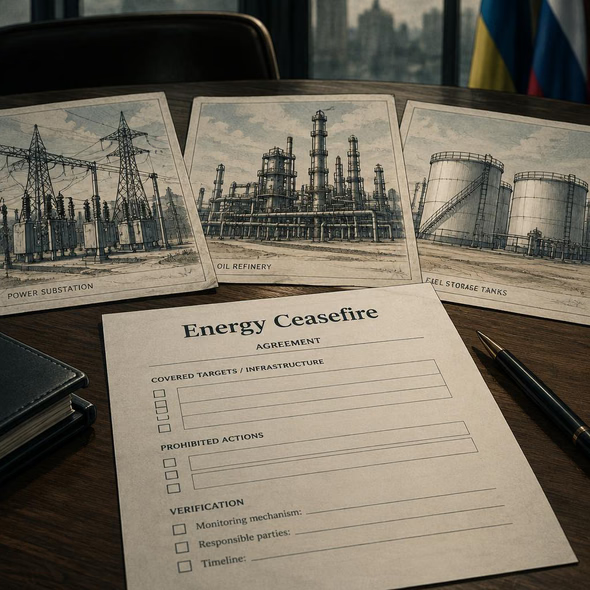
Granted, limited restraint can deliver real protection without ending a war. Still, Trump’s announcement is not evidence of implementation: the assessment turns on matching commitments, defined targets, and independently assessed strikes, not the capitalization of the promise.
US President Donald Trump announced on social media on October 11 that Russia and Ukraine had agreed to an “energy ceasefire,” effective immediately. Reuters reported his claim, and Al Jazeera reproduced the announcement. The supplied reporting does not establish independently confirmed terms from both governments or demonstrate that attacks have stopped.
Ukrainian President Volodymyr Zelensky had sought something broader. Speaking to ABC on Sunday, Zelensky said he would organize elections if Russian President Vladimir Putin agreed to a 60-day total ceasefire. That proposal and Trump’s announcement are not interchangeable. A pause covering energy targets would leave other fighting outside its protection unless the parties explicitly agreed otherwise.
Granted, a limited agreement need not be dismissed as diplomatic decoration. Protecting electricity and fuel infrastructure could reduce civilian hardship while negotiations over a wider ceasefire continue. Al Jazeera reports that mutual attacks on energy infrastructure have pressured global energy prices. Both civilian protection and price relief are legitimate stakes, although neither follows automatically from an announcement.
Still, “energy” is a category, not an operational instruction. Do the proposed protections cover power stations, substations, refineries, pipelines, and fuel storage? Do they prohibit only direct strikes, or also actions intended to disable the same facilities indirectly? These are questions for published terms, not a target list we can infer. Trump has supplied the agreement’s title; the people expected to obey it need the small print.
Agreement, implementation, and verification require different evidence. Matching statements from Moscow and Kyiv would help establish what each government accepted. Orders to the relevant forces would address implementation. Credible reporting on subsequent strikes would test compliance, with attention to timing, attribution, and whether the affected facility falls within the agreed scope. A disputed incident would not explain itself merely because someone called it a violation.
The strongest case for this announcement is that a narrow bargain could secure restraint where a comprehensive settlement remains unavailable. The weakest case is that undefined protections let each government claim compliance while accusing the other of cheating. Confirmations from Russia and Ukraine, published terms, and independently assessed strike evidence would move the judgment toward either outcome. Until then, the defensible description is a claimed agreement, not an accomplished reduction in violence.
Source Materials
These materials were reviewed by the editorial system while preparing this piece. Muerte.casa may interpret, satirize, reframe, or disagree with them.
- Trump says Russia and Ukraine reached 'energy ceasefire' Reuters · October 11, 2026 · Primary signal · Direct source
- Trump says Ukraine and Russia agree to ‘energy ceasefire’ Al Jazeera · October 11, 2026 · Direct source
How did this story land?
This may be changed as you like.