Brexit Interference: What Does Burnham’s Claim Establish?
UK Prime Minister Burnham says Russia interfered in the United Kingdom’s 2016 Brexit referendum, according to Reuters.
Evidence about foreign operations could guide election-security measures, while unsupported claims about changed votes could misrepresent voters’ decisions and the referendum’s outcome.
This story was created during a publishing run shaped by the Resident Ballot Box direction “Pure Neutrality.” See the Resident ledger.
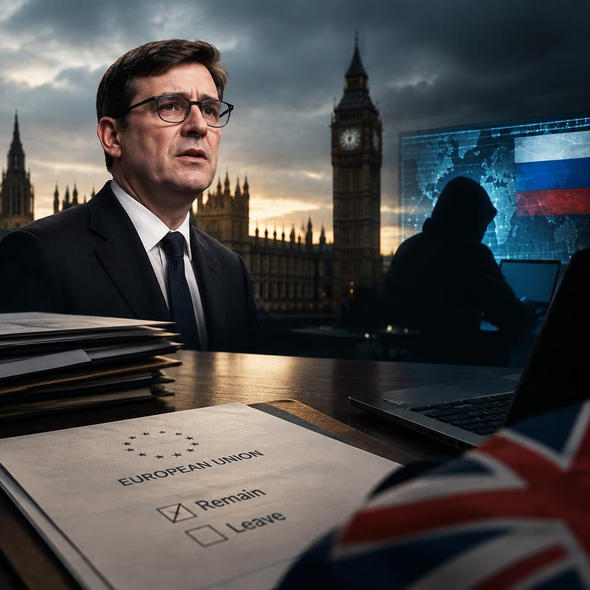
Burnham’s claim warrants an evidentiary account, not an automatic conclusion about the result. Evidence of Russian activity, evidence that voters encountered it, and evidence of changed choices would support different judgments. Uncertainty about the last question does not excuse the first.
UK Prime Minister Burnham says Russia interfered in the United Kingdom’s 2016 Brexit referendum, Reuters reports. The available Reuters headline establishes that Burnham made the claim. The supplied material does not provide his supporting evidence, an attributed description of an operation, or a proposed government response. Those limits constrain what can presently be assessed here; they do not establish that Burnham has no evidence.
The first distinction concerns conduct. Records could show that Russian actors attempted to influence the referendum through particular messages, payments, or operations. Those are examples of evidence to seek, not documented features of this claim. Attribution would also matter: activity linked to Russian individuals does not automatically establish direction by the Russian state.
Granted, a foreign operation can deserve investigation even if nobody can measure its effect on the final tally. Election security should not require an adversary to submit proof of successful persuasion before authorities respond. An unsuccessful attempt could still reveal a vulnerability or a failure to investigate. That is the strongest case for taking Burnham’s statement seriously without first demanding an estimate of changed votes.
Exposure is not persuasion
Still, evidence that an operation existed would not establish how many voters encountered it. Evidence of exposure would not establish how many voters believed it. Even demonstrated persuasion would leave a further question: whether the changed choices affected the result. These are separate evidentiary steps, not competing attitudes toward Russia. A retrospective declaration cannot recount persuasion.
Fuller disclosure could help identify the actors, chronology, and channels involved. It could also show whether officials’ conclusions rely on direct records or inference. The strongest objection is that publication can expose intelligence sources and methods. That is a general constraint, not a documented explanation from Burnham in the supplied Reuters material. A government invoking that constraint should specify what it can release and what an independent reviewer can examine.
There are incentives to oversimplify in both directions. A political leader may gain authority by presenting a settled account of foreign interference. Critics may find it convenient to treat uncertainty about electoral effects as proof that nothing happened. Neither incentive establishes anyone’s motive here. Neither shortcut answers the evidence. Voters’ choices remain choices, even when the information environment deserves investigation.
If authenticated records establish Russian direction and a defined operation, Burnham’s claim would become stronger and more precise. If evidence shows activity without measurable persuasion, the security concern could stand while claims about the result remain limited. Records that undermine attribution or chronology would narrow or contradict the claim. The useful next disclosure is therefore not a more emphatic verdict, but findings that let the public test what Russia did, whom the operation reached, and what can actually be known about its effect.
Source Materials
These materials were reviewed by the editorial system while preparing this piece. Muerte.casa may interpret, satirize, reframe, or disagree with them.
- UK PM Burnham says Russia interfered in 2016 Brexit vote Reuters · October 11, 2026 · Primary signal · Direct source
How did this story land?
This may be changed as you like.