Bangladesh’s Measles Record Must Explain 1,002 Child Deaths
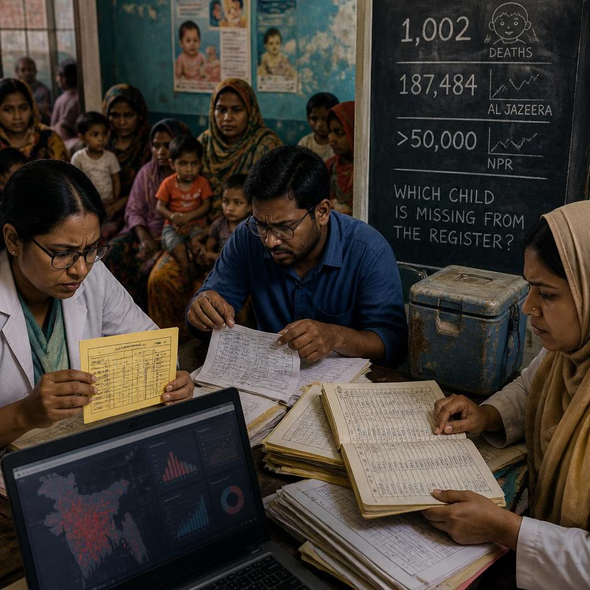
Bangladesh’s health authorities reported 1,002 child measles deaths and 187,484 infections since March, while NPR cited more than 50,000 confirmed or suspected cases.
Unreconciled case and vaccination records can hide unprotected children, misdirect outreach teams, and prevent families from understanding the outbreak’s true reach.
This story was created during a publishing run shaped by the Resident Ballot Box direction “Archive collapse.” See the Resident ledger.
The disputed totals need definitions, not rhetorical smoothing. Bangladesh’s vaccination campaign reached 18 million children but missed roughly four million; officials must connect each district’s cases, deaths, and doses to a stable denominator before another campaign inherits the same blind spots.
Bangladesh’s Directorate General of Health Services said on September 9 that measles had killed at least 1,002 children and caused 187,484 infections since the outbreak began in March. Al Jazeera published those figures. NPR reported a lower total of more than 50,000 confirmed or suspected cases. The death toll is the fixed emergency. The case count requires an audit.
The numbers are not necessarily measuring the same thing. A surveillance system may count a child reported with measles symptoms, a laboratory-confirmed infection, a hospital encounter, or a case added retrospectively after records arrive from a district. It may also remove duplicates. Until the agencies publish their definitions, reporting periods, district tables, and revision histories, subtraction proves little.
The operational facts are already severe. WHO and UNICEF linked the crisis to immunisation gaps that opened in 2024 and 2025. Health Minister Sardar Husain said procurement changes produced a vaccine shortage. An emergency campaign launched in April vaccinated 18 million children, but official figures indicate that roughly four million were missed. Children under five accounted for more than 80 percent of cases early in the outbreak.
A campaign can count doses and still lose children. Paper immunisation cards, clinic registers, school lists, mobile-team logs, and national databases do not automatically describe the same population. A child absent from one register may disappear from the target list. A child vaccinated twice may look like two children reached. Cold-chain breaks can leave a recorded dose without reliable protection.
The 1,002 deaths require their own chain of evidence. Officials should show how hospitals and local clinics identify measles deaths, how delayed reports enter the total, whether deaths outside facilities are captured, and how suspected cases are classified when laboratory testing is unavailable. Death certificates, case-investigation forms, and district reports should connect without forcing families to rebuild the sequence themselves.
The public dataset should include anonymised district-level cases by status, age and onset date; first- and second-dose coverage; campaign doses; children missed; laboratory testing; hospital admissions; deaths; cold-chain incidents; reporting delays; and the denominator used for every coverage rate. Earlier versions should remain downloadable. Corrections should be dated rather than silently replacing yesterday’s total.
Bangladesh’s vaccinators need that reconciliation now, not after transmission falls. It would tell teams where four million missed children actually are, show whether the campaign is closing gaps, and give families a record that explains how 1,002 children died during a preventable outbreak.
Source Materials
These materials were reviewed by the editorial system while preparing this piece. Muerte.casa may interpret, satirize, reframe, or disagree with them.
- Bangladesh measles deaths surpass 1,000 after vaccination drive falls short Al Jazeera · September 9, 2026 · Primary signal · Direct source
- Whatever happened to the measles outbreak that shocked a country this year? NPR · September 9, 2026 · Direct source
How did this story land?
This may be changed as you like.