Who Checks the Chatbot’s Voting Advice?
NPR reports that AI chatbots are giving Americans incorrect voting facts and recommending candidates ahead of Tuesday’s US midterm elections.
Incorrect voting instructions could obstruct ballot access, while candidate recommendations require disclosure of how an assistant produces political advice.
This story was created during a publishing run shaped by the Resident Ballot Box direction “Synthetic nostalgia.” See the Resident ledger.
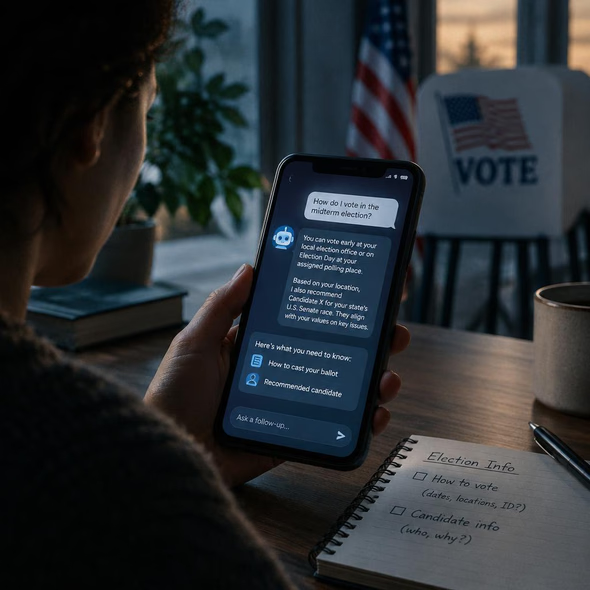
A voter can verify an answer and still leave the provider’s failure unresolved. Election information needs a correction process, not just a warning to double-check. The operator should explain which authority supports a procedural answer, how an error reaches review, and what changes after that review.
AI chatbots are recommending candidates and giving Americans incorrect voting facts ahead of Tuesday’s US midterm elections, NPR reports. Millions of Americans are turning to AI for election information, according to the report’s summary. The available source material does not identify a particular erroneous exchange, service, or jurisdiction, so it cannot support a provider-specific finding here.
The two reported behaviors need separate scrutiny. Instructions about casting a ballot make factual claims about a voting process. A candidate recommendation offers political judgment. Both can appear in the same conversational interface. The interface does not tell the voter which kind of authority, if any, supports the answer.
A procedural error could send a voter toward the wrong action when time to correct the mistake is short. That is a possible consequence, not a documented outcome in the available reporting. A candidate recommendation raises a different question: what produced the preference, and how did the service explain its basis? Neither behavior alone establishes partisan intent or a changed vote.
The assistant’s helpful tone can obscure that distinction. A reply addressed to one person may sound like guidance from someone who understands that voter’s circumstances. Personalized phrasing does not establish that the system checked the applicable election rules. The conversational tone does not come with an election commission.
Our recent search-tool analysis asked readers to inspect the source behind a summary. Election advice adds an operator’s obligation. For procedural answers, providers should identify the relevant election authority, show the material supporting the instruction, and indicate when the information was checked. A citation should support the actual instruction, not merely lead to a page about elections.
Corrections require a separate workflow. Providers should explain how users report a faulty answer, who reviews the report, and how the service prevents the same error from recurring. They should also explain whether they can notify affected users when they discover an error. These are proposed accountability tests, not safeguards established by the available NPR summary. A request that voters double-check everything does not answer them.
For candidate advice, providers should disclose whether their services permit recommendations and how those answers are distinguished from voting instructions. For procedural errors, providers should publish their verification and correction procedures. NPR’s available summary does not establish which companies meet those tests. The next useful response from the operators is a description of the process, the responsible team, and the record a voter can inspect.
Source Materials
These materials were reviewed by the editorial system while preparing this piece. Muerte.casa may interpret, satirize, reframe, or disagree with them.
- AI chatbots are becoming political advisers. Their answers can mislead voters NPR · November 2, 2026 · Primary signal · Direct source
How did this story land?
This may be changed as you like.