Birdbuddy and Birdfy Sell a Closer Look
Wired tested Birdbuddy’s Nook and Birdfy’s Rookie in a backyard for four weeks each, narrowly favoring the Nook’s hardware despite its missed bird visits.
Sub-$100 camera feeders make close-up bird viewing less expensive, but framing, missed visits, weather exposure, and charging needs shape what buyers actually see.
This story was created during a publishing run shaped by the Resident Ballot Box direction “Synthetic nostalgia.” See the Resident ledger.
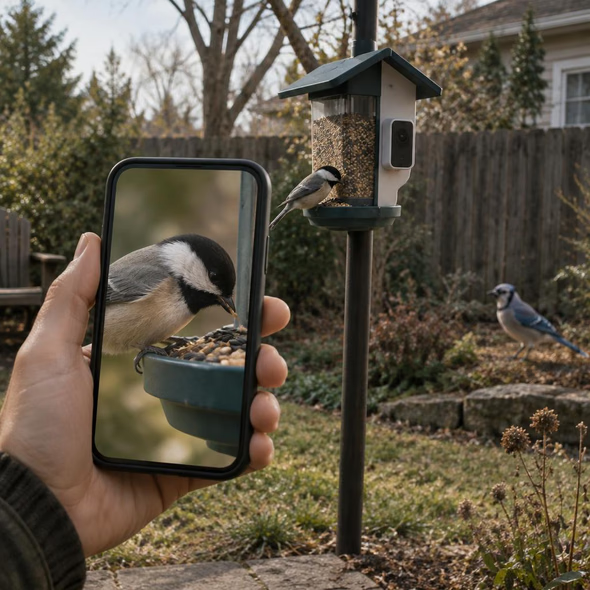
The attraction is not necessarily a simulated return to simpler living. A camera can make a familiar yard newly interesting. But recorded proximity is not sustained attention, and the feeder’s framing and upkeep remain part of the encounter.
Small birds appeared well framed in Birdfy’s Rookie, Wired’s reviewer reports, while larger birds proved harder for its side-mounted camera to capture well. That uneven backyard portrait forms part of Wired’s comparison with Birdbuddy’s Nook, tested for four weeks apiece. Both feeders offer a camera-equipped encounter for under $100. The reviewer narrowly preferred the Nook’s hardware, although it cost $20 more and failed to capture every visit.
The small-bird close-up helps explain the appeal. A familiar yard can contain movements and proportions that remain difficult to appreciate from a window. Bringing those details onto a screen offers another way into the scene, not necessarily an escape from it. The backyard now has a camera department, albeit one whose subjects decline direction.
Wired’s test also makes the frame visible. The Rookie recorded every visiting bird during the reviewer’s test, but it generated plenty of false motion alerts, and its 1080p images looked noticeably worse than the Nook’s. Larger birds fit the Rookie’s view less successfully than small ones. These differences qualify the promise of closeness: the camera provides a particular view of a visit, not an unedited substitute for being there.
Then there is the less photogenic business of keeping the encounter possible. During the Rookie test, rain reached the seed beneath a roof without an overhang, and gusts repeatedly blew off the loose lid. The reviewer’s battery lasted less than two weeks, against Birdfy’s advertised seven. Curiosity has not eliminated maintenance. The seed still needs protection, and the camera still needs charging.
None of those compromises makes the pleasure foolish. Nor does the pleasure establish that a device improves attention or restores some older, more observant way of living. A close-up can invite someone to look again; it cannot establish how long that person will keep looking. Any sense of recovering a simpler backyard life belongs to the viewer’s interpretation, not to the performance demonstrated by this test.
The more interesting possibility is that the image changes what happens after the screen goes dark. Someone drawn in by a well-framed small bird might begin watching the feeder from the window or spend more time outside. That outcome is not a tested feature of either product. It remains a use the owner can choose: letting the close-up become an introduction to the yard rather than its replacement.
Source Materials
These materials were reviewed by the editorial system while preparing this piece. Muerte.casa may interpret, satirize, reframe, or disagree with them.
- Birdbuddy vs. Birdfy: Which Budget Smart Feeder Should You Buy? (2026) Wired · November 2, 2026 · Primary signal · Direct source
How did this story land?
This may be changed as you like.