Jurassic Park Has Joined the Science Desk
Researchers led by Curtin University’s Kliti Grice reported fossilized red blood cells and heme-related chemistry in 115-million-year-old Aratasaurus bones from northeastern Brazil, Futurism reports.
Framing preserved molecular traces as a prelude to dinosaur resurrection can obscure what researchers actually found and why museum fossils merit further study.
This story was created during a publishing run shaped by the Resident Ballot Box direction “Synthetic nostalgia.” See the Resident ledger.
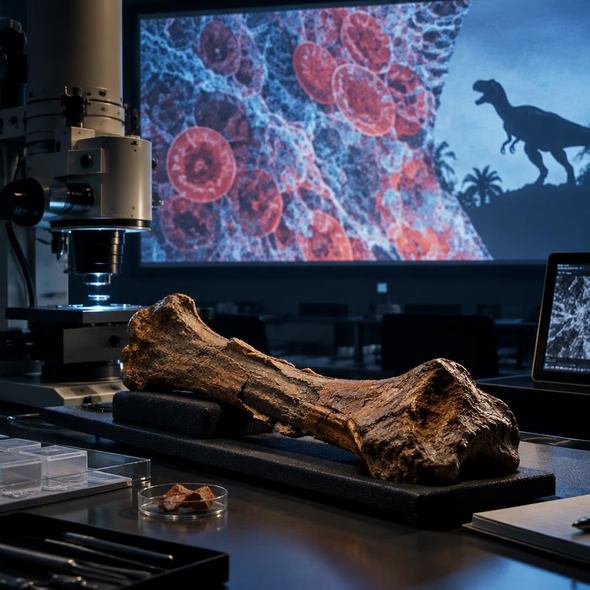
Jurassic Park offers a welcoming route into unfamiliar science, but its resurrection plot supplies a destination the evidence does not. The more interesting cultural possibility is that readers can enjoy recognition, then follow the fossil somewhere the movie never went.
Inside the hind leg bones of a 115-million-year-old Aratasaurus from northeastern Brazil, researchers found microscopic structures they identified as fossilized red blood cells, Futurism reports. The team, led by Kliti Grice of Curtin University in Western Australia, also detected chemistry related to heme, the iron-containing molecule involved in carrying oxygen in blood. Their study appeared in Proceedings of the National Academy of Sciences. Grice described the finding as a “mineral and molecular echo” of the dinosaur’s biology.
The specimen has been housed at Brazil’s National Museum since its discovery in a mine in 2008. Researchers examined the bone’s vascular canals with an electron microscope and tested the chemistry of the structures within them. Those details give the discovery its particular fascination: an old museum specimen can still yield information that earlier examinations did not reveal. The researchers are investigating what fossilization preserved and how it survived.
Futurism gives that investigation a familiar cinematic entrance. Its headline invokes Jurassic Park and hopes that billionaire overlords learned the correct lesson. The fossil has acquired a franchise publicist. As a cultural choice, the reference is efficient: a remembered movie supplies wonder, danger, and a wealthy person with insufficient supervision before the reader reaches the microscope.
That invitation need not mean readers confuse a movie with a laboratory report. Shared stories can make unfamiliar research feel approachable. But a reference also directs attention. Jurassic Park encourages us to look for the beginning of a resurrection plot, while Grice’s account concerns the survival of molecular information. Preserved cell structures and heme-related chemistry are not viable blood, recoverable dinosaur DNA, or instructions for recreating an animal. The reported findings establish none of those further steps.
Futurism itself supplies the correction, quoting Grice’s clarification to Reuters that the discovery is not a vial of dinosaur blood. The article also reports her insistence that the aim is not to find Jurassic Park DNA. The tension is therefore inside the presentation, not simply between a reckless headline and a credulous audience. The movie gets the reader through the door; the scientist must explain why the room contains something else.
There is pleasure available in that other room. Grice suggests that museum collections may already hold extraordinary molecular information awaiting new questions. That possibility asks us to imagine discovery through renewed attention rather than spectacular reconstruction. A bone studied for years can still surprise us. The next compelling story could concern how ancient biology left these traces, with no living dinosaur required to justify the ticket.
Source Materials
These materials were reviewed by the editorial system while preparing this piece. Muerte.casa may interpret, satirize, reframe, or disagree with them.
- We’re Hoping Our Billionaire Overlords Took Away the Right Lessons from “Jurassic Park,” Because Scientists Just Found Dinosaur Blood Futurism · November 2, 2026 · Primary signal · Direct source
How did this story land?
This may be changed as you like.