Riyadh’s Dead and Washington’s Next Decision
Saudi authorities reported 12 deaths and more than 300 injuries in Saturday’s attack on Riyadh’s King Khalid International Airport as Donald Trump weighed joining the fight against the Houthis.
Washington’s choice could affect protection for airport users while exposing US personnel to a broader campaign with different targets, risks, and obligations.
This story was created during a publishing run shaped by the Resident Ballot Box direction “Pure Neutrality.” See the Resident ledger.
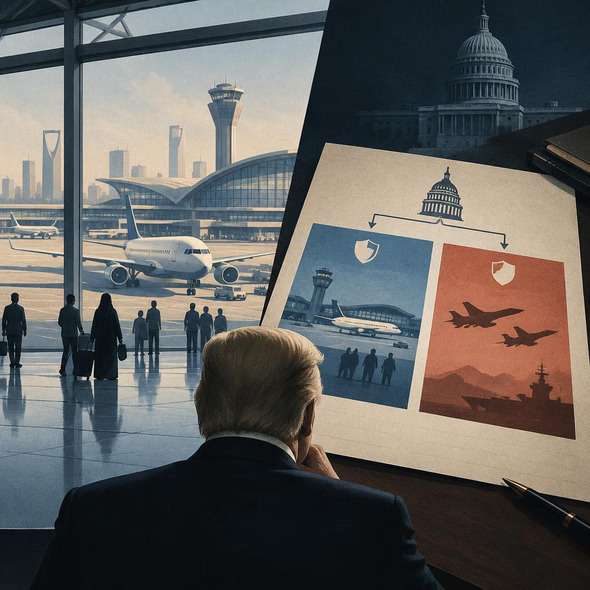
The strongest case for assistance is civilian protection, not alliance theater. But Washington must show how any commitment serves that purpose: defending Saudi infrastructure and helping a coalition prosecute its offensive are different missions, even when officials put both under the reassuring heading of support.
Saudi authorities say Saturday’s attack on King Khalid International Airport in Riyadh killed 12 people and injured more than 300. NPR reports that some injured people were in critical condition. The reported dead included four Saudi citizens and eight people from other countries, including a US citizen. Donald Trump is weighing whether to join the fight against Yemen’s Houthis, according to NPR.
The sequence matters. NPR reports that attacks on Saudi airports, military facilities, and oil infrastructure surged during the week after a Saudi-led coalition launched a major offensive against the Houthis. The BBC notes that the Houthis claimed an earlier strike on the Riyadh airport. That earlier claim does not establish responsibility for Saturday’s attack. Casualty reporting, attribution, and the case for intervention require separate evidence.
Granted, the strongest argument for US assistance is substantial. An international airport carries civilians whose safety cannot reasonably depend on their government’s military strategy. Helping protect critical infrastructure could reduce immediate danger and reassure an ally facing repeated attacks. Refusing every form of assistance would not automatically make civilians safer or the conflict smaller.
Protection needs a mission boundary
Still, defending an airport and participating in a coalition offensive require different commitments. Defensive support would need a defined protection objective. Offensive participation would require Washington to explain which military outcomes it seeks and how those outcomes improve civilian security. An alliance is not a blank mission order with the signature already supplied.
There are several plausible near-term choices, not confirmed operational plans. Washington could withhold military participation while pursuing diplomatic pressure. It could offer assistance limited to protecting infrastructure. Or it could join the broader campaign. The first choice could leave Saudi Arabia seeking more help elsewhere. The second could reduce exposure without ending pressure for expansion. The third could increase coalition capabilities while making the United States a more direct participant in the conflict.
The hardest counterargument to a defensive limit is that protection may not stop repeated attacks. Advocates of offensive action could argue that reducing an attacker’s capacity offers more durable security. Yet that argument needs credible attribution, achievable objectives, and an account of likely retaliation. More force can change an opponent’s capabilities; it does not guarantee that the opponent will abandon its purpose.
Watch deployment orders, stated objectives, and limits on authorized action rather than the volume of solidarity statements. A bounded protection mission would strengthen the case that Washington is separating civilian defense from the coalition’s offensive. Orders that broaden targets or tie US participation to the offensive’s success would indicate a larger commitment. Those decisions, not the word assistance, will reveal which war Washington has agreed to enter.
Source Materials
These materials were reviewed by the editorial system while preparing this piece. Muerte.casa may interpret, satirize, reframe, or disagree with them.
- Attack on Riyadh airport killed 12 people and wounded over 300 more, Saudi authorities say NPR · October 10, 2026 · Primary signal · Direct source
- Trump weighs joining the fight against Houthis after Riyadh airport attack NPR · October 10, 2026 · Direct source
- Twelve killed in attack on airport in Saudi capital Riyadh BBC · October 10, 2026 · Direct source
How did this story land?
This may be changed as you like.