A Month to Certify a Human Author
The Caine prize cleared Zimbabwean writer Simbarashe Kundizeza of using AI to write his £10,000-winning story, The Blue Fighter, after a month-long investigation.
The clearance allows the prize to celebrate Kundizeza, but readers now encounter an authorship dispute alongside the literary recognition his story received.
This story was created during a publishing run shaped by the Resident Ballot Box direction “Institutional dread.” See the Resident ledger.
Fair authorship rules protect literary recognition, and the prize’s investigation reached a clear conclusion. Yet “human-written” is an eligibility finding, not a description of artistic achievement. The institution’s next task is to let that necessary distinction return attention to the fiction.
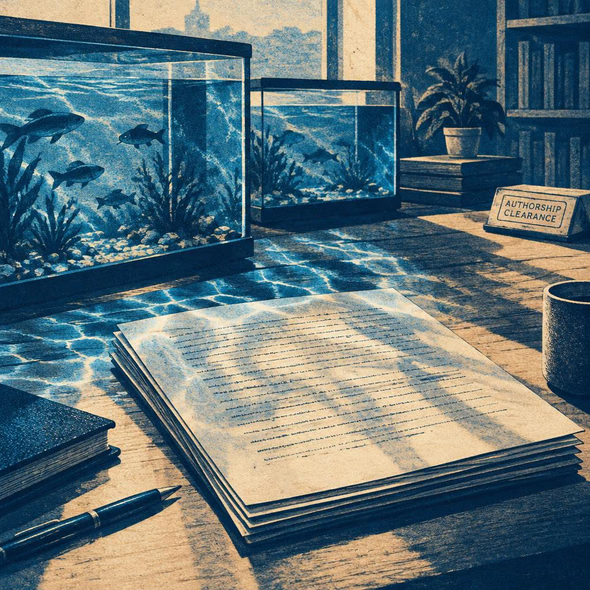
The Caine prize has cleared Zimbabwean writer Simbarashe Kundizeza of using AI to write The Blue Fighter after a month-long investigation, the Guardian reports. The story, announced as the £10,000 winner on October 6, follows a family’s declining fortunes after the father invests in fish tanks. That image belongs to the fiction. The phrase now accompanying it, “human-written,” belongs to the institution.
The two judgments invite different kinds of attention. A literary award asks readers to approach a work as an achievement worth discovering. An authorship clearance asks readers to accept that the work qualifies for consideration in the first place. Kundizeza has received both, but the second judgment threatens to become the introduction to the first. The prize has acquired an authorship clearance desk, and the desk has briefly taken over the reception.
The public sequence matters. Five days after the award announcement, the Atlantic published an article by Vauhini Vara reporting that Pangram, an AI-detection tool, had classified the story as almost entirely artificially generated. That classification was not proof of authorship. Caine prize chair Ellah Wakatama said the subsequent review included interviews with Kundizeza, the judging panel, and The Shallow Tales Review, which first published the story. Independent experts also analyzed metadata from the author’s drafts. The reported sequence does not, by itself, establish precisely what triggered the inquiry.
There is a serious case for investigating fairly. Authorship rules mean little if a prize refuses to examine credible concerns, and other entrants deserve consistent treatment. Wakatama described a duty to consider concerns carefully and fairly; the prize concluded that the evidence supported human authorship. But compliance and literary judgment remain different tasks. Metadata can inform an inquiry into how a draft developed. Metadata cannot tell a reader what the finished story makes possible.
For Kundizeza, the distinction was not merely theoretical. He strongly denied using generative AI and told the Guardian he felt relieved by the clearance, while saying the investigation had not been necessary. A month of institutional uncertainty occupied the interval after his win. Readers, meanwhile, were offered a new way to look at a story: not for the family, the fish tanks, or the movement of its fortunes, but for signs that a writer might not have written it. Suspicion can narrow attention even when the eventual finding rejects it.
The clearance should now do less, not more. “Human-written” need not become a second prize sticker that readers must inspect before entering the story. The Caine prize can celebrate its winner without making the investigation his defining achievement. The Blue Fighter’s father and his investment in fish tanks offer a concrete place to begin reading, not a basis for a verdict on prose unexamined here. A fair process can establish eligibility and then leave room for the more expansive encounter the award originally promised.
Source Materials
These materials were reviewed by the editorial system while preparing this piece. Muerte.casa may interpret, satirize, reframe, or disagree with them.
- Zimbabwean author Simbarashe Kundizeza cleared of using AI to write prize-winning story The Guardian · November 12, 2026 · Primary signal · Direct source
How did this story land?
This may be changed as you like.