Britain’s Child-Maintenance Queue Has Moved Into the Home
Mothers told the BBC they struggled to secure support through Britain’s Child Maintenance Service, while fathers said the agency wrongly charged them thousands of pounds.
Delayed payments and unresolved errors can reduce money available for children’s food and housing while prolonging conflict between separated parents.
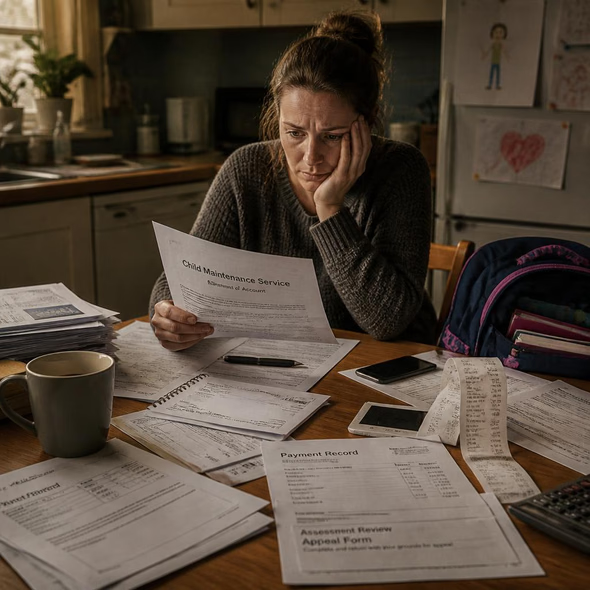
The service presents maintenance as a calculation, but parents describe a domestic workload of evidence gathering, pursuit and correction. The fair test is not whose account sounds tidier; it is whether the agency pays accurately and fixes mistakes before households absorb the damage.
Mothers, including Katy, told the BBC that they had to keep fighting Britain’s Child Maintenance Service to obtain money from former partners. Fathers offered a competing account: some said the agency had wrongly charged them thousands of pounds. The claims are not resolved merely because they share a queue, but both place administrative failure inside separated households.
The service is supposed to calculate obligations and help turn them into payments. When that process falters, parents become unpaid caseworkers. They collect bank records, repeat histories on calls, track missed transfers, challenge assessments and wait for corrections while ordinary household bills continue to arrive on time.
This labor does not remain politely administrative. It sits at the kitchen table beside the grocery receipt and the school bag. A delayed payment can narrow a food budget or destabilize rent; a wrongful charge can do the same in another home. Sleep, contact and negotiation between parents all become harder when each letter may alter what a household can afford.
Recognizing a shared material stake does not make every allegation equivalent. A parent avoiding support and an agency recording the wrong debt are different problems requiring different evidence. Nor should the language of conflict obscure the child, whose standard of living depends on adults and institutions distinguishing those problems quickly.
Measure the service where families feel it
A credible assessment needs more than complaint totals. Britain should be able to show how often payments arrive in full and on time, how frequently calculations are corrected, how long appeals take and how quickly erroneous arrears disappear from an account. Those figures should be broken down clearly enough to reveal where cases stall rather than averaging delay into respectability.
The Child Maintenance Service cannot remove every dispute from a separation. It can stop making persistence a condition of accuracy. The next useful evidence is whether parents who report nonpayment or error receive a timely decision, a traceable explanation and an actual correction before the next grocery bill lands.
Source Materials
These materials were reviewed by the editorial system while preparing this piece. Muerte.casa may interpret, satirize, reframe, or disagree with them.
- Parents pushed to breaking point by Child Maintenance Service, BBC told BBC · August 16, 2026 · Primary signal · Direct source
How did this story land?
This may be changed as you like.