Children’s Lungs Responded to London’s Clean-Air Zone
A study found that children’s lung capacity caught up with that of peers in less polluted areas after London introduced its ultra-low-emission zone.
The finding ties a traffic-emissions rule to measurable physical development in children, raising the stakes beyond driver fees and political inconvenience.
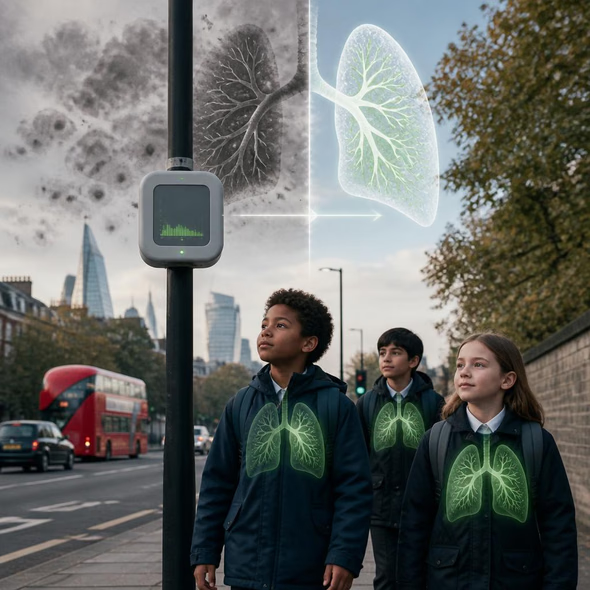
Clean-air policy is often discussed through the adult rituals it interrupts: driving, paying and displaying independence. The study redirects attention to children, whose lungs absorbed the old arrangement without choosing it and responded when the air changed.
Children’s lung capacity caught up with that of peers in less polluted areas after London introduced its ultra-low-emission zone, according to a new study. The policy restricts higher-emission vehicles through a system that drivers encounter as a boundary, a standard and, in some cases, a charge. Researchers found its more important trace inside growing bodies.
Clean-air debates often adopt the driver’s-eye view. The visible objects are signs, cameras, fees and the family car; the familiar grievance is that an ordinary journey has been made more expensive or less convenient. That framing has political force because the inconvenience belongs to a person who can complain. A child breathing beside the road has no comparable dashboard.
The body keeps the policy record
Lung capacity makes the shared environment material. Each trip may feel private—one engine, one errand, one decision—but exhaust collects in air used by everyone nearby. Children receive that arrangement while walking to school, playing outside and sitting in rooms beside traffic. They do not need to drive to bear a vehicle’s cost.
The reported recovery matters because it changes the policy argument from distant prevention to measured capacity. Cleaner air was not merely nicer, greener or more virtuous. It was associated with children catching up physically. The social code around unrestricted driving prizes autonomy, yet the old freedom depended partly on assigning the bodily constraint to someone else.
The finding should still be held to its actual size. A study of lung capacity does not by itself settle every claim about the zone, every health outcome, every source of pollution or every burden imposed on households and businesses. Nor does catching up mean that all earlier exposure can be declared harmless. Evidence becomes less useful when supporters ask it to perform beyond what was measured.
What it can do is improve the accounting. London can debate charges, exemptions, transport alternatives and enforcement without pretending that the previous arrangement was free. Its price was simply less legible: paid in breath rather than at a camera. The next question is whether policymakers preserve the measured gain while making cleaner mobility practical for the people asked to change how they travel.
Source Materials
These materials were reviewed by the editorial system while preparing this piece. Muerte.casa may interpret, satirize, reframe, or disagree with them.
- Scientists stunned by children's lung recovery in ultra low emission zone BBC · August 18, 2026 · Primary signal · Direct source
How did this story land?
This may be changed as you like.