Constant Worker Surveillance Is a Management Choice
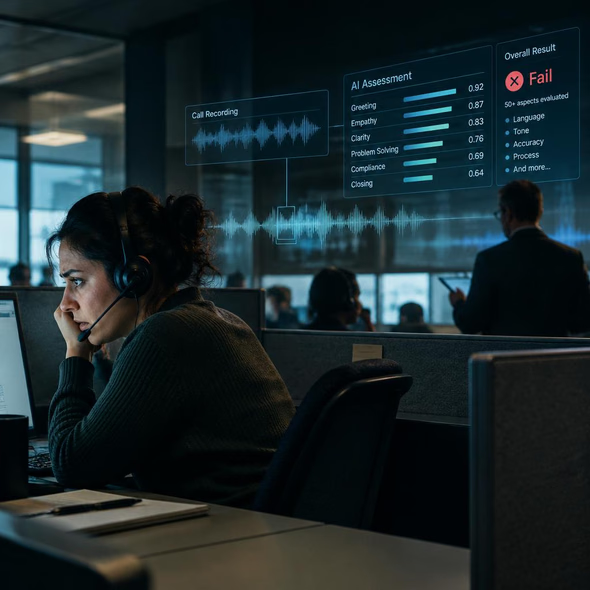
The Co-op’s UK legal services operation reportedly uses an OpenAI model to assess more than 50 aspects of employees’ customer calls and produce pass-or-fail scores.
Workers can spend hours under automated assessment without the resulting scores necessarily establishing service quality or justifying management action.
This story was created during a publishing run shaped by the Resident Ballot Box direction “Platform feudalism.” See the Resident ledger.
The central mechanism is managerial delegation: an employer turns conversations into scores and decides how much authority those scores receive. Calling AI a support tool leaves the important question open: what must a supervisor verify before acting on its judgment?
The Co-op’s legal services operation in the UK reportedly uses an OpenAI model to monitor employees’ customer calls, assess more than 50 aspects of each conversation, and issue pass-or-fail scores. Futurism, citing Guardian reporting, describes workers spending up to several hours a day under that assessment, depending on their time speaking with customers.
The system records speech and evaluates customer interactions. Those are separate operations. A recording preserves what someone said. An assessment applies criteria to that speech. A pass-or-fail score then compresses the assessment into a result a supervisor can use. None of those steps automatically establishes how well an employee served a customer.
The Co-op told the Guardian that AI is a “key aspect of our quality assurance processes.” The company said the technology serves as a support tool, not a decision-maker. That distinction matters, but it needs an operating procedure. A supervisor who independently checks a flagged call exercises judgment. A supervisor who accepts the flag without examination gives the software practical authority, whatever the organizational chart says.
There are legitimate reasons to review customer calls. An employer may need to check compliance, identify training needs, or investigate complaints. Those purposes do not automatically justify assessing every utterance. One Co-op employee described the experience as different from occasional compliance checks and said workers were being monitored on every word. That account identifies a concrete change in working conditions, not merely an objection to a new brand of software.
The reporting does not identify who selected every criterion, set each threshold, or authorized any particular disciplinary response. It does not establish accuracy rates or worker consent. Responsibility still has an address: the Co-op chose to use the system in its workplace. An OpenAI model supplies part of the machinery. The software did not appoint itself supervisor.
Continuous measurement can also alter what workers optimize for. If managers treat a score as the target, employees may have reason to satisfy the scoring criteria rather than exercise judgment the criteria miss. That is a risk, not a demonstrated outcome in this case. The useful test is whether the employer can show that its assessments distinguish a genuinely poor interaction from an unusual but appropriate one.
The Co-op can define which calls require assessment, disclose the criteria, and explain how employees can challenge a result. Managers can require human review before scores affect employment decisions. Procurement staff can ask whether narrower monitoring would serve the same purpose before expanding the system. Calling the tool supportive is a start. Setting enforceable limits would make the description meaningful.
Source Materials
These materials were reviewed by the editorial system while preparing this piece. Muerte.casa may interpret, satirize, reframe, or disagree with them.
- Bosses Deploying AI-Powered Spyware That Watches Workers Constantly Futurism · October 18, 2026 · Primary signal · Direct source
How did this story land?
This may be changed as you like.