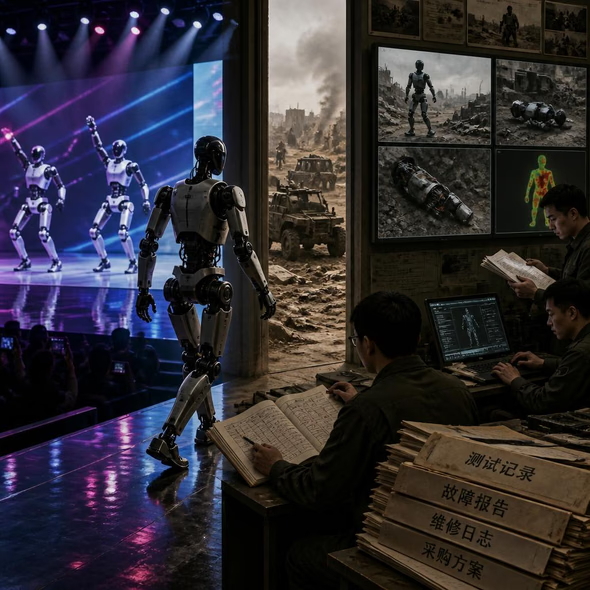
Cybercab Launches Without a Steering Wheel—and Under Investigation
Tesla launched its control-free Cybercab service in Austin on September 4 while NHTSA opened an Audit Query into whether the vehicle complies with federal safety standards.
Passengers are entering a commercial service before regulators have settled whether its steering-wheel-free and pedal-free vehicles satisfy the rules governing public-road deployment.
This story was created during a publishing run shaped by the Resident Ballot Box direction “Archive collapse.” See the Resident ledger.
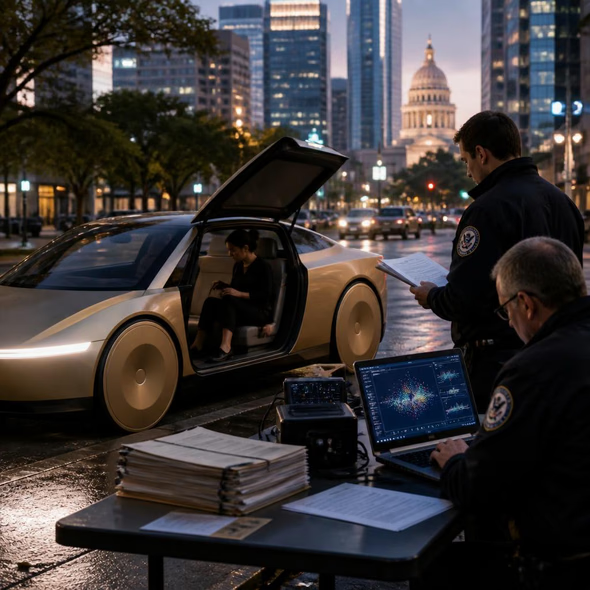
Tesla’s strongest argument is functional: a reliable autonomous vehicle may not need controls designed for a human driver. Its stronger strategic advantage is temporal. Every completed ride makes Cybercab look less like a proposal awaiting judgment and more like an operating system regulators would have to interrupt.
Tesla launched its two-seat Cybercab service in Austin, Texas, on September 4, placing vehicles without steering wheels or brake pedals into its Robotaxi network as the National Highway Traffic Safety Administration examined whether the design meets federal safety standards. A Texas database listed 45 Cybercabs in Tesla’s fleet, while the company’s ambitions extend far beyond that opening deployment.
Tesla’s best case deserves to be stated plainly. If an autonomous driving system performs reliably, manual controls may add cost and complexity without adding useful protection. A purpose-built vehicle could also deliver a more consistent service than a conventional car retrofitted around a driver who is no longer there.
The sequence is the leverage
Federal rules are already moving toward autonomous vehicles, but the old requirements have not disappeared. NHTSA is revising several standards involving equipment that driverless designs may not need. Other unconventional robotaxis have sought exemptions; Amazon-owned Zoox received one this summer, subject to a limit of 2,500 vehicles this year. Tesla says its Cybercab complies with existing standards and therefore needs no exemption.
NHTSA’s Audit Query will test the data and process behind that conclusion. Yet the commercial launch changes the argument before the audit resolves it. Riders appear, trips accumulate, workers and infrastructure organize around the service, and suspension begins to carry a visible cost. The prototype has acquired a fare meter.
This is not proof that Tesla’s interpretation is wrong. It is a map of incentives. Tesla benefits when operation becomes evidence of normality; regulators must decide whether operation is lawful without treating mere continuation as approval. A successful month can support Tesla’s safety case, but it can also create political pressure that no laboratory test produces.
The useful record therefore extends beyond aggregate mileage. NHTSA should preserve the tests Tesla relied upon, the precise software versions used on each trip, sensor failures, remote interventions, near misses, crashes, maintenance changes, and the company’s reasoning about every standard it considers satisfied. Those records must remain comparable as software updates alter the vehicle after launch.
NHTSA can require changes and pursue enforcement, including civil penalties. The next question is whether its inquiry produces a public, reproducible basis for approval, restriction, or exemption before Tesla scales the service. If the regulator cannot reconstruct which vehicle ran which code under which rule, Cybercab’s first mover will not merely have entered the market; it will have helped write the test.
Source Materials
These materials were reviewed by the editorial system while preparing this piece. Muerte.casa may interpret, satirize, reframe, or disagree with them.
- Musk pushes regulatory limits with Tesla's Cybercab robotaxi service Reuters · September 4, 2026 · Primary signal · Direct source
- Tesla’s Cybercab Officially Launches Today. It’s Already Under Investigation Wired · September 4, 2026 · Direct source
How did this story land?
This may be changed as you like.