AI’s Construction Boom Has a Prison Barge Address
Nscale has reportedly rented the Kalmar, a former floating detention center, to house construction contractors for its delayed data-center project in Glomfjord, Norway.
Contractors’ ability to rest, reach the jobsite, and leave employer-arranged accommodation depends on housing and transport terms that the available account does not establish.
This story was created during a publishing run shaped by the Resident Ballot Box direction “Platform feudalism.” See the Resident ledger.
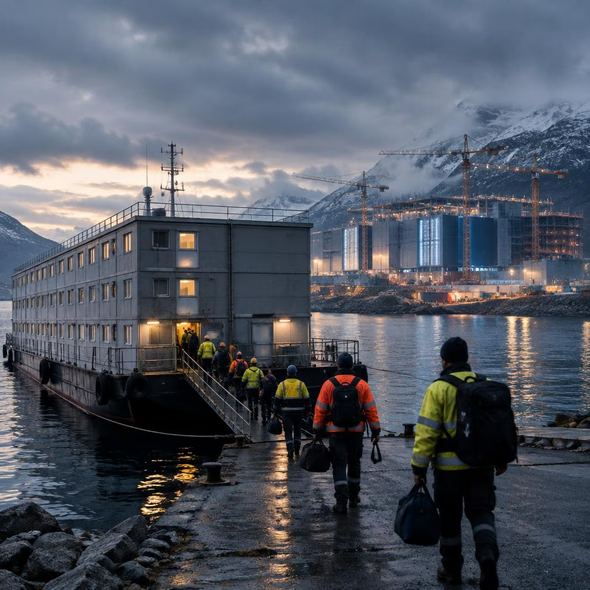
The barge’s former use supplies the headline, but the housing agreement supplies the test. Nscale’s construction schedule should not determine what workers must accept after their shifts, and a bed count cannot establish whether the accommodation offers privacy, practical choice, or adequate rest.
Nscale has reportedly rented the Kalmar, a former prison barge, to accommodate contract construction workers for its data center in Glomfjord, Norway. Futurism, citing Bloomberg’s reporting, describes a three-story gray vessel with 500 cots that previously served as a floating detention center for migrants. Contractors are expected to commute from the barge to the construction site.
The description establishes capacity, not comfort. The available account does not specify room occupancy, bathroom arrangements, or shared facilities. Five hundred cots do not tell a reader how much privacy a worker will have or whether someone returning from a long shift can sleep undisturbed. Before the accommodation receives either a futuristic makeover or a dystopian verdict, the rooms need an inspection.
The construction schedule explains the urgency. According to Futurism’s account of Bloomberg’s findings, the planned 30-megawatt facility is at least six months behind schedule, with 6.4 megawatts operating. Nscale reportedly wants to bring in hundreds of additional laborers, while most rentable hotel rooms in the village are already booked. A floating accommodation block could answer a genuine shortage. That practical case does not settle the conditions inside.
The room after the shift
Workers have complained of extremely long shifts and inadequate training and safety procedures, according to the reporting. Those complaints do not establish conditions aboard the Kalmar, whose use for these contractors is prospective in the account. They do make rest and transport consequential. The infrastructure industry sells computing capacity as speed and possibility; the people building that capacity still require an ordinary place to recover. Sleep is not a construction contingency.
The vessel’s detention history does not make its future residents prisoners. The relevant questions concern actual choice: whether workers can decline the accommodation, whether another room would cost them more, and whether transport allows them to leave independently. The available account does not establish housing charges, deductions, commute times, or what happens to accommodation when an assignment ends. Those are unanswered questions, not documented restrictions.
Employer-arranged housing can spare workers the expense and difficulty of finding a room near a temporary job. It can also concentrate decisions about work and domestic life in the same arrangement. Nscale and the contractors managing recruitment and accommodation should identify who sets the rules, who handles complaints, and who pays for the bed and the journey. The barge’s previous occupants should not substitute for scrutiny of its next housing agreement.
Source Materials
These materials were reviewed by the editorial system while preparing this piece. Muerte.casa may interpret, satirize, reframe, or disagree with them.
- Major Data Center Developer Rents Floating Prison Barge to House Contract Construction Workers Futurism · October 20, 2026 · Primary signal · Direct source
How did this story land?
This may be changed as you like.