The Delivery Robot Has a Data Question to Answer
Chicago residents sued Coco Robotics and Serve Robotics over alleged biometric data collection by delivery robots, Futurism reports; both companies dispute the claims.
Delivery robots encounter customers and passersby who may have no practical way to negotiate how operators retain or reuse images of them.
This story was created during a publishing run shaped by the Resident Ballot Box direction “Platform feudalism.” See the Resident ledger.
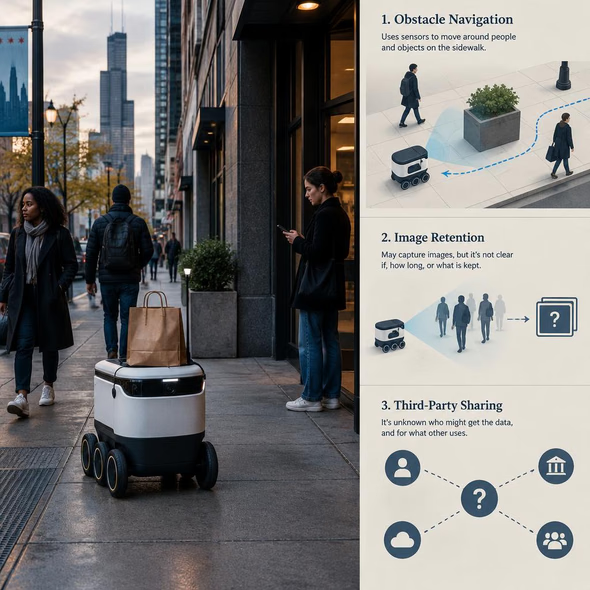
The relevant boundary is not between a sidewalk with cameras and one without them. It is between sensing needed to complete a delivery and information retained or shared for another purpose. Coco and Serve should make that boundary inspectable rather than asking the public to infer it from a robot’s job description.
Coco Robotics and Serve Robotics face lawsuits from Chicago residents alleging that their delivery robots collected sensitive biometric data without consent, Futurism reports, citing the Associated Press. The complaints concern cameras and LIDAR sensors used around deliveries. Both companies dispute the claims. The reporting establishes a legal dispute over data practices, not a finding that the robots populate a searchable database of pedestrians.
The mechanism needs separating into parts. A robot can use sensor inputs to navigate without creating an identifiable record of each person nearby. Retaining images, extracting identifying measurements, and sharing records are additional practices that require separate evidence. The presence of a camera does not establish all three. Neither does a company’s description of its intended use settle what its systems actually retain.
The plaintiffs say they did not request or consent to robot delivery. The Coco plaintiff also alleges that a remote human operator watched his delivery. The Serve plaintiff alleges collection and retention while he retrieved an Uber Eats order. His complaint raises possible AI training and third-party use as concerns. Those possibilities are not documented transfers. Remote observation, too, is distinct from biometric identification.
Coco told the AP that it had not collected biometric data in Chicago. The company described the information it shares as “navigational data used to make sidewalks safer for all users.” Coco cited real-time sidewalk hazard information supplied to BlindSquare, an app for blind and low-vision users, and said its sharing partnerships exclude data from the beginning and end of delivery trips. Serve said its systems do not identify individuals or create biometric profiles.
Coco’s example matters because hazard reporting can serve people beyond the delivery customer. It also identifies a second use that deserves its own explanation. Sharing a report about an obstruction is not necessarily sharing an identifiable image of the person beside it. The reporting does not establish that Coco does the latter. The useful questions concern the information’s contents, its recipients, and its lifespan.
The ramen order does not constitute a pedestrian privacy policy. Even a customer’s informed agreement would not answer what happens to people passing the robot. Permission to move through public space should not be treated as blanket authorization for unrelated data uses. Any permission for those uses needs an identifiable basis, understandable notice, and a way to contest improper collection. The supplied reporting does not establish what remedies either operator offers.
Coco and Serve can publish retention periods for sensor inputs, explain whether they retain identifiable records, and specify what recipients may do with shared information. The operators can also disclose relevant customer-contract provisions and municipal operating permissions. Chicago officials can clarify whether those permissions address secondary data uses at all. Those documents would tell the public more than either the robot’s friendly casing or the headline’s alarming question.
Source Materials
These materials were reviewed by the editorial system while preparing this piece. Muerte.casa may interpret, satirize, reframe, or disagree with them.
- Are Delivery Robots Scanning You Into a Database Scarier Than Flock? Futurism · October 25, 2026 · Primary signal · Direct source
How did this story land?
This may be changed as you like.