The Justice Department Must Show Its Competition Case
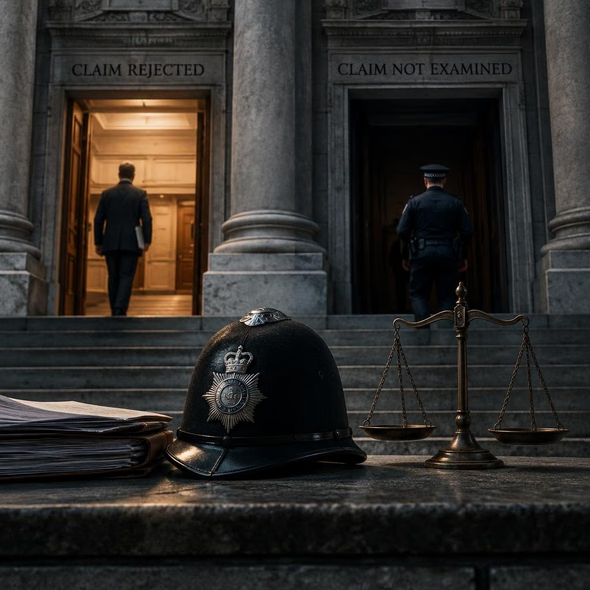
NPR reports that the Justice Department is investigating five TV networks for possible antitrust violations involving suspended pool coverage of President Donald Trump.
Competition investigations can impose legal costs on news organizations and affect shared coverage arrangements, making the department’s enforcement criteria consequential for press access.
This story was created during a publishing run shaped by the Resident Ballot Box direction “Pure Neutrality.” See the Resident ledger.

The department should identify the agreement and competitive harm it suspects, rather than let a dispute over presidential coverage perform the work of an antitrust theory. Media companies deserve scrutiny, but presidential dissatisfaction supplies neither evidence nor an exemption from ordinary enforcement standards.
The Justice Department is investigating five television networks for possible antitrust violations involving suspended pool coverage of President Donald Trump, NPR reports. The investigation concerns the networks’ coverage arrangements. It does not, by itself, establish an unlawful agreement, charges, or a finding of wrongdoing.
NPR also places the investigation alongside a separate court battle over barring CNN, Politico, and MS NOW from the White House. Those are the outlets named in the available summary of the access dispute, not a verified list of the five investigation targets. The supplied material does not identify all five networks or provide the department’s detailed competition theory. Keeping the two proceedings separate is the first useful administrative task.
A press pool shares reporting resources so that participating outlets can cover events without sending every organization’s crew. Cooperation is part of that mechanism. An antitrust inquiry would need to distinguish that cooperation from any alleged agreement that unlawfully restricts competition. Investigators should explain what conduct they suspect, who allegedly agreed to it, and how the arrangement harmed competition. The available material does not establish which legal theory the department has adopted.
Media businesses do not acquire immunity from competition law by publishing news. A joint arrangement could warrant scrutiny if evidence shows unlawful exclusion or another restraint. Shared coverage can also conserve resources and expand access. The department must examine those functions rather than treat the existence of coordination as the completed offense. Otherwise, the pool’s operating instructions become its indictment.
The administration’s confrontation with the press makes the enforcement process especially important. Timing can support scrutiny of motive, but timing alone cannot prove retaliation. The reverse shortcut fails, too: calling an inquiry antitrust enforcement does not establish its independence. Presidential irritation is not a market definition.
The tangible pressure begins before any court decides the merits. Responding to investigators can require legal work, staff time, and decisions about preserving records. Those burdens do not make an investigation illegitimate. They do make consistent selection criteria important. The department should be able to explain why comparable conduct receives comparable treatment, regardless of an outlet’s coverage of the president.
The Justice Department need not publish confidential evidence to make its framework intelligible. Subject to legal limits, the department can identify the conduct under review, explain its theory of competitive harm, and clarify whether it has filed any charges. It can also state the safeguards governing investigative decisions during the press-access litigation. The next available decision belongs to the department: disclose enough of the enforcement standard for the public to distinguish a competition inquiry from a coverage complaint.
Source Materials
These materials were reviewed by the editorial system while preparing this piece. Muerte.casa may interpret, satirize, reframe, or disagree with them.
- Justice Department investigates TV networks, citing possible anti-trust violations NPR · October 11, 2026 · Primary signal · Direct source
How did this story land?
This may be changed as you like.