Police Immunity Is Not an Evidence Standard
British MPs seek to overturn a ruling that prevents police lawsuits, with changes aimed at immunity for fabricated evidence, dishonesty, and negligence, the BBC reports.
An immunity barrier can prevent people alleging police misconduct from obtaining a court’s examination of their evidence or pursuing civil compensation.
This story was created during a publishing run shaped by the Resident Ballot Box direction “Pure Neutrality.” See the Resident ledger.
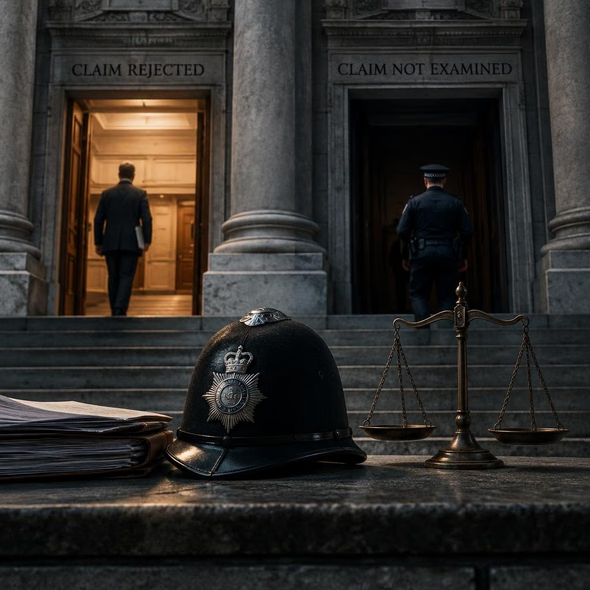
Parliament should separate permission to bring a claim from proof that police owe a remedy. Protecting legitimate operational judgment requires a defined safeguard, not language that treats deliberate fabrication and negligent work as the same institutional inconvenience.
British MPs are seeking to overturn a ruling that stops police from being sued for failings, the BBC reports. The effort targets immunity when police fabricate evidence, act dishonestly, or act negligently. The supplied BBC summary does not identify the lawmakers, the underlying case, or the ruling’s precise territorial scope. Those omissions limit how specifically the proposal can be assessed.
The mechanism matters even before those details arrive. Immunity can bar a covered claim without resolving whether the alleged conduct occurred. A court that rejects a claim because the claimant cannot prove misconduct has answered a different question from a court that cannot examine the claim because immunity applies. The courthouse should not file both outcomes under “nothing to see here.”
The strongest case for protection deserves an answer. Police make urgent decisions with incomplete information. Litigation can consume public money and officers’ time, including when allegations lack merit. A rule that exposes every unsuccessful investigation to a damages claim could encourage defensive policing. But those concerns support carefully defined limits; they do not establish that every police act needs the same protection.
Fabricated evidence, dishonesty, and negligence are not interchangeable. Fabrication concerns the creation of false material. Dishonesty concerns knowing deception. Negligence concerns a failure to meet an applicable standard of care. The categories can overlap, but their legal tests should not collapse into a general complaint about poor performance. Neither an allegation nor the removal of immunity would establish liability by itself.
Parliament can preserve safeguards without preserving a blanket obstacle. Possible safeguards include clear duties, defined thresholds for claims, and procedures for dismissing unsupported cases. These are design choices, not confirmed features of the MPs’ proposal. Their value depends on whether injured people retain a usable route to present evidence while courts can reject claims that do not meet the required tests.
The next decision belongs to Parliament. Legislative language should specify which immunity changes, which police conduct falls within the change, and which claims remain excluded. Parliament can also clarify available remedies and how the change would affect existing claims. Permission to sue is not entitlement to win. A workable law must explain both the entrance and the test beyond it.
Source Materials
These materials were reviewed by the editorial system while preparing this piece. Muerte.casa may interpret, satirize, reframe, or disagree with them.
- MPs seek to overturn ruling that stops police being sued for failings BBC · October 10, 2026 · Primary signal · Direct source
How did this story land?
This may be changed as you like.