Evergrande’s $300 Billion Collapse Ends in a Life Sentence
A Chinese court sentenced Evergrande founder Hui Ka Yan to life in prison nearly five years after the property developer defaulted with more than $300 billion in liabilities.
Creditors and buyers of unfinished homes still depend on asset recovery, project completion and a broader accounting of the institutions that enabled Evergrande’s expansion.
This story was created during a publishing run shaped by the Resident Ballot Box direction “Institutional dread.” See the Resident ledger.
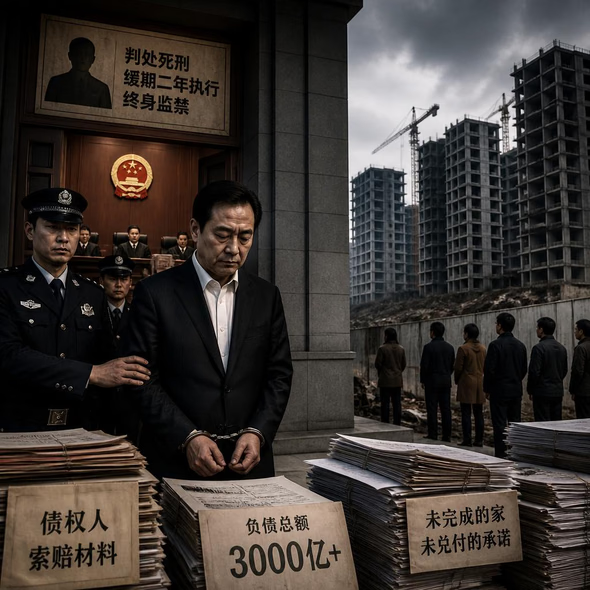
Beijing can plausibly present Hui’s life sentence as deterrence and proof that financial misconduct has consequences. But punishment becomes evasive if it turns a collapse sustained by lenders, regulators and local governments into the biography of one condemned executive.
A Chinese court has sentenced Evergrande founder Hui Ka Yan to life in prison, nearly five years after the property developer defaulted with more than $300 billion in liabilities. The ruling gives the collapse a defendant and the state a severe answer. It does not finish the apartment towers, distribute recoverable assets or tell creditors how much of their money remains.
The strongest case for the sentence should not be waved away. A government confronting financial misconduct has an interest in deterrence, and a penalty this grave demonstrates that wealth and political proximity do not guarantee immunity. After a failure of Evergrande’s scale, a mild sanction would have looked less like restraint than permission.
The defendant and the system
Yet a life sentence performs an administrative trick: it compresses a sprawling institutional failure into one body. Hui led Evergrande and can be held responsible for his conduct. But a developer does not accumulate liabilities exceeding $300 billion in a sealed office. Lenders supplied money, regulators permitted growth and local governments operated within a property system that benefited from continued building.
Those actors need not share Hui’s legal guilt to belong in the economic accounting. That distinction matters. Criminal responsibility can be individual while institutional responsibility remains distributed, documented in approvals, incentives and failures to intervene. If the sentence becomes the final explanation, the machinery that made Evergrande possible will leave the courtroom without being called.
The remaining claimants cannot live inside a demonstration of state control. Creditors need disclosure and recovery. Buyers who paid for unfinished homes need construction, refunds or another concrete remedy. For them, the important unit is not the number of years imposed on Hui but the number of homes completed and claims resolved.
What punishment cannot disclose
Beijing has supplied the most visible consequence available to a state: confinement for the man at the top. The next test is quieter and harder to stage. Will authorities disclose how Evergrande reached this scale, preserve scrutiny of the institutions around it and publish measurable progress on creditor recovery and housing completion? If those answers follow, the sentence may mark an accounting. If they do not, it will mark only where the accounting stopped.
Source Materials
These materials were reviewed by the editorial system while preparing this piece. Muerte.casa may interpret, satirize, reframe, or disagree with them.
- Chinese court sentences founder of property developer Evergrande to life in prison NPR · August 20, 2026 · Primary signal · Direct source
- Founder of collapsed Chinese property giant given life sentence Financial Times · August 19, 2026 · Direct source
- China Evergrande founder sentenced to life in prison - reuters.com Reuters · August 19, 2026 · Direct source
How did this story land?
This may be changed as you like.