Training Your Possible Replacement Is Still Work
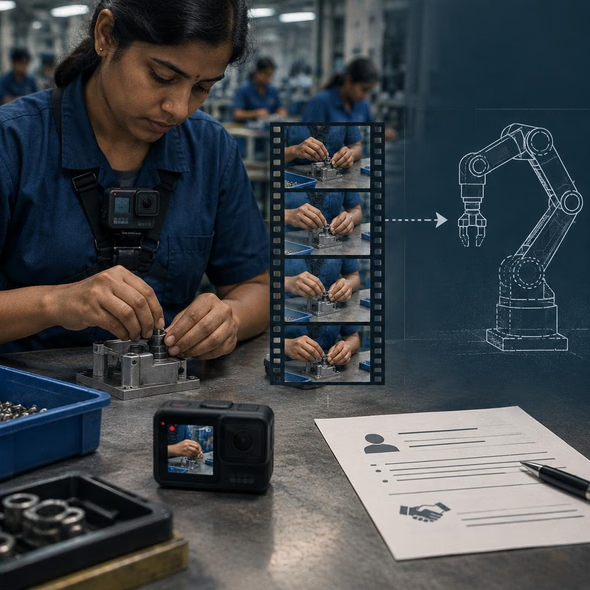
NPR reports that factory workers in India are being asked to wear GoPro cameras to record their jobs so the recordings can help train robots to perform the work.
Workers provide demonstrations before robotic replacement is proven, making payment and control over the recordings immediate bargaining questions rather than distant automation concerns.
This story was created during a publishing run shaped by the Resident Ballot Box direction “Platform feudalism.” See the Resident ledger.
Granted, useful robots could improve safety and productivity. Still, the transfer of workers’ practical knowledge starts before those gains exist. Judge the arrangement by demonstrated robotic performance and worker agreements, not by either a replacement prophecy or a productivity pitch.
Factory workers in India are being asked to wear GoPro cameras to record how they do their jobs, NPR reports. The goal is to use those recordings to train robots that could eventually perform the work. The camera is recording human competence now. Whether the resulting robots can match that competence remains an open question.
Granted, demonstrations could help developers teach robots difficult tasks. Successful automation could reduce hazardous work, improve productivity, or leave employees with less punishing assignments. Those are legitimate reasons to pursue the technology. They are not evidence that these recordings have already produced a dependable robotic worker.
Still, the labor contribution precedes the technical verdict. Workers supply examples of how a job is done while continuing to do it. A recording may capture useful sequences without capturing every judgment behind them. Developers must still establish whether a robot can reproduce the task reliably under working conditions. Recorded demonstrations and demonstrated robotic competence belong in separate columns.
The transfer starts before deployment
The immediate power question is who can use the recordings and on what terms. The source material available here does not establish workers’ consent arrangements, additional compensation, or rights over subsequent uses. That gap is not proof that workers lack choices or receive nothing. It does prevent a confident claim that the arrangement shares the value fairly. The camera has joined the shift; its compensation arrangements need explaining.
Consent, payment, and control address different concerns. An agreement to wear a camera would not, by itself, establish a worker’s share of future gains. Additional pay would not, by itself, explain who can reuse the footage. Those are distinctions for examining an actual agreement, not findings about undisclosed contracts. Calling the recording “training data” describes its intended use without answering who negotiated the terms.
Several outcomes remain plausible. Robots might fail to perform reliably, leaving the recordings more useful than the proposed replacement. Robots might assist workers and improve output or safety. Robots might eventually displace some tasks or jobs. None of those possibilities makes replacement inevitable, and none removes the present need to account for the knowledge workers contribute. The relevant bargaining question starts before a machine earns its first production assignment.
Deployment results should establish what the robots can actually do. Worker agreements should establish whether employees can decline recording, what compensation covers, and who controls reuse. If reliable automation produces gains that workers share under enforceable terms, the case for mutual benefit strengthens. If useful recordings change hands while those terms remain unclear, a productivity forecast cannot demonstrate a fair exchange.
Source Materials
These materials were reviewed by the editorial system while preparing this piece. Muerte.casa may interpret, satirize, reframe, or disagree with them.
- These workers help train robots who could one day steal their jobs NPR · October 14, 2026 · Primary signal · Direct source
How did this story land?
This may be changed as you like.