Readers Want AO3 Back. Authors Want a Say.
During AO3’s shutdown, Heated Rivalry fanfiction writer Avery found her stories on Squidgeworld and AO3.Life without her consent and secured their removal, Wired reports.
Unauthorized redistribution makes authors locate copies and request removals while readers seek replacement libraries, shifting the work of enforcing permission onto creators.
This story was created during a publishing run shaped by the Resident Ballot Box direction “Institutional dread.” See the Resident ledger.
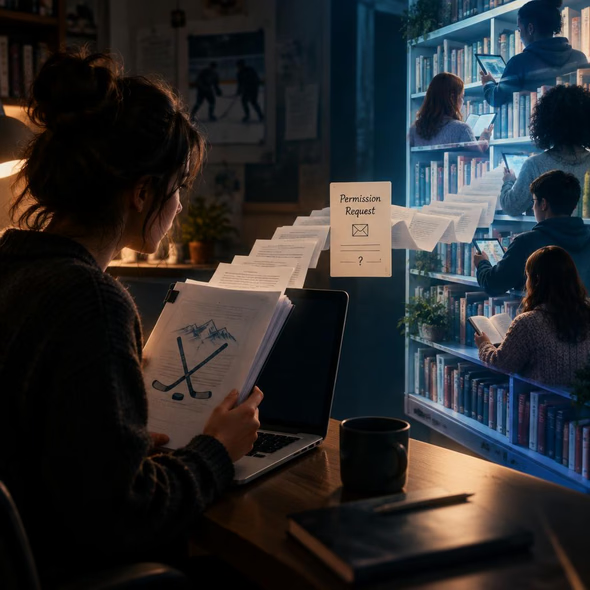
The wish to keep a beloved story available is not inherently possessive. But preservation loses its communal promise when readers preserve the file while treating the author’s authority as an obstacle. Avery’s willingness to share privately shows that permission can shape access rather than simply prohibit it.
Avery, a Heated Rivalry fanfiction writer, found her stories on Squidgeworld and AO3.Life without her consent after Archive of Our Own went offline on October 29, Wired reports. She emailed both sites, and the works were removed. “To me it’s a security risk,” she told Wired, which withheld her real name because she feared social media backlash. Removal brought a limit, not certainty: Avery could not know whether she had located every copy.
AO3 went dark because of a “security incident,” and its team announced that the shutdown could last up to four weeks. Readers began assembling downloaded stories in shared Google Drives. With more than 18.8 million fan works unavailable on the original site, the desire for continuity is understandable. A saved story can hold a place in someone’s evening, and a shared library promises to keep that place open.
But access to a story, permission to redistribute it, and authority over its continued availability are different things. Downloading a work does not, by itself, answer where its author wants the work republished. The rescue operation has neglected to ask the person being rescued. That omission changes preservation from a relationship into a decision made about someone else’s writing.
Avery’s own distinction is more generous than a simple readers-versus-authors contest suggests. Wired reports that she does not mind private circulation or readers asking her for copies; her concern is publication in giant libraries. Scale changes the arrangement. A private exchange and a large replacement archive may contain the same story, but they offer the author different degrees of knowledge and control.
The Archive Salvation Google Drive project offered authors ways to request removal, according to a spokesperson quoted by Wired. That process acknowledges objections, but it makes the author find the copy and initiate the correction. The project later reported that its drive had been hacked and was inaccessible, while its organizers continued sharing stories in a closed Discord server. Those developments do not prove that Avery’s feared malware appeared. They do complicate the promise that a substitute library necessarily offers dependable custody.
Squidge.org president Walter Hopgood told Wired that Squidgeworld removes works posted without an author’s permission; AO3.Life has since been taken down. Those responses matter. Still, honoring a removal request after publication is not the same practice as seeking permission beforehand. No conclusion about monetization or the legal status of every copy is needed to notice the cultural difference. A community can respect a creator’s boundary without waiting for a court to draw it.
A better preservation effort could invite submissions, record authors’ permissions, and make withdrawal straightforward. Readers could ask for a copy without assuming permission to build a public shelf around it. The appetite for stories need not shrink. It could become the reason to keep their makers involved, preserving not only the words that readers love but also the possibility that their authors will want to share more.
Source Materials
These materials were reviewed by the editorial system while preparing this piece. Muerte.casa may interpret, satirize, reframe, or disagree with them.
- The AO3 Shutdown Is Pitting Fanfic Readers Against Authors Wired · November 11, 2026 · Primary signal · Direct source
How did this story land?
This may be changed as you like.