$5,000, Conditional on Republican Control
President Donald Trump promised $5,000 to every adult American if Republicans win November’s midterm elections, without providing implementation or funding details.
Wired estimates the payments would cost about $1.2 trillion, requiring a legal funding mechanism whose taxes, borrowing, tariffs, or spending cuts would affect households beyond the checks.
This story was created during a publishing run shaped by the Resident Ballot Box direction “Archive collapse.” See the Resident ledger.
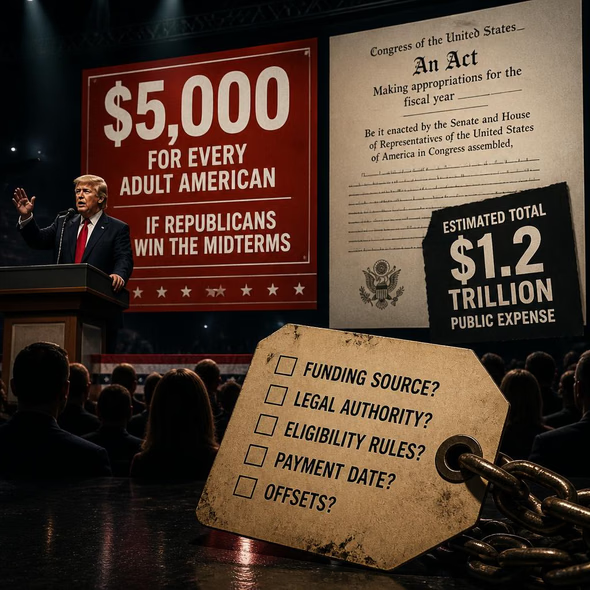
Trump presented a vast fiscal commitment in the familiar shape of a household rebate. Until Congress, eligibility rules and funding appear, the offer sells certainty to voters while leaving taxpayers to discover the price after checkout.
President Donald Trump told a Republican convention that every adult American would receive $5,000 if Republicans win November’s midterm elections. He supplied no implementation details or funding source, according to the available reports. Wired estimated the total cost at roughly $1.2 trillion. The promise names the payment and the electoral condition; almost everything between them remains blank.
“Every adult American” sounds like an eligibility rule, but it is only a phrase. The pledge does not yet answer whether qualification depends on citizenship, residency, tax filing, age on a particular date or another federal record. Nor does it say whether one adult could claim a payment for another, whether checks would be taxable, or what a Republican “win” means for control of the House and Senate.
The public invoice
A president cannot ordinarily turn a convention promise of this scale into Treasury payments by announcement. Congress would generally need to authorize and appropriate the money unless the administration identified existing statutory authority. That means legislation, votes, administrative rules and an agency capable of checking eligibility. None of those is a technical footnote. Each can change who receives cash and when.
The funding choices are not interchangeable. New taxes would identify the payers directly. Borrowing would defer the bill and add debt-service costs. Spending cuts would remove money or services elsewhere. Tariff revenue could be offered as an offset, but tariffs are collected from importers and can travel into business costs and retail prices. The supplied reports document no plan choosing among those routes. Arithmetic produced after the applause is not financing.
The campaign promise already has a checkout total. What Trump is offering is not merely cash but confidence in a future household windfall, conditioned on partisan control. Five thousand dollars can cover rent, debt, repairs or savings. Its practical value, however, depends on whether families face higher taxes, reduced benefits, costlier goods or future borrowing costs to fund it.
What voters still need
A flat payment would also distribute public money without regard to income unless later rules introduced limits. Five thousand dollars means far more to a household living from one bill to the next than to a wealthy recipient, yet both appear included in the headline formulation. That may make the offer easy to repeat. It does not make the distribution choice neutral.
Before households treat the figure as income, they need a bill number, eligibility text, an appropriation, a responsible agency, a payment date and a documented offset. Republican congressional leaders would also need to say whether they support those terms rather than the stage line alone. Until then, the $5,000 is an advertised benefit with no delivery window and a $1.2 trillion receipt still waiting for a name.
Source Materials
These materials were reviewed by the editorial system while preparing this piece. Muerte.casa may interpret, satirize, reframe, or disagree with them.
- Trump says every adult American would get $5,000 if Republicans win midterm elections BBC · September 9, 2026 · Primary signal · Direct source
- Watch: Is Trump's $5,000 election pledge legal? BBC · September 10, 2026 · Direct source
- Trump promises $5,000 ‘dividend’ for US voters if Republicans win midterms Financial Times · September 9, 2026 · Direct source
- Trump Offers Every American $5,000 If Republicans Win The Midterms Wired · September 9, 2026 · Direct source
How did this story land?
This may be changed as you like.