The Cyber Model Has a Restricted Entrance. Its Rivals Do Not.
Vals tested AI models on simulated corporate networks, and Wired reports that DeepSeek and GLM performed not far behind OpenAI’s restricted-access Daybreak model.
Network operators cannot assume that restricting access to one provider’s strongest model keeps comparable hacking capabilities out of attackers’ reach.
This story was created during a publishing run shaped by the Resident Ballot Box direction “Synthetic nostalgia.” See the Resident ledger.
A trusted-access program controls one supplier’s distribution, not the market’s capabilities. The useful test is whether the restriction preserves a measurable defensive advantage, and whether network operators use that time to fix weaknesses.
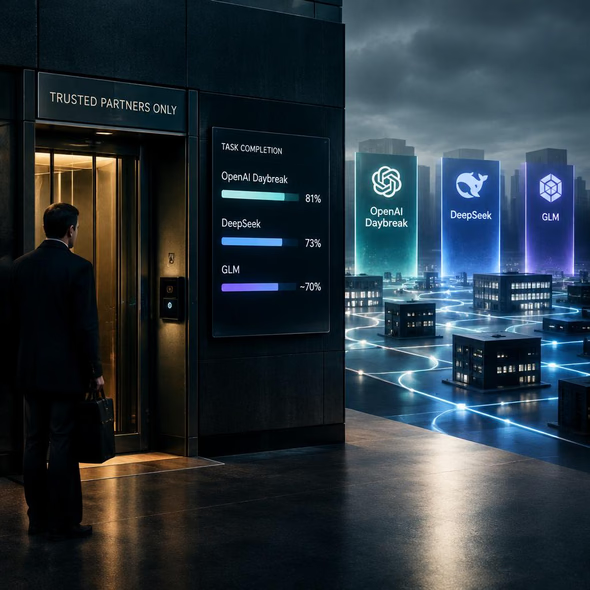
Vals, a company that measures AI capabilities, tested models on mock corporate networks. OpenAI’s Daybreak, available only to trusted partners, completed 81 percent of assigned tasks on average across two tests, Wired reports. DeepSeek completed 73 percent. Wired also reports that GLM performed not far behind Daybreak.
The experiment used two scenarios. One involved a mock corporate network reached through a public-facing website. The other required a model to compromise one company’s network to reach another. These were tests of multistep work inside simulated environments, not reports of intrusions into operating businesses. Task completion does not establish stolen records, disrupted services, or demonstrated harm.
The access mechanism is narrower than the security ambition. OpenAI can decide who receives Daybreak. That decision does not determine who can obtain another supplier’s capable model. The restricted entrance does not cover the whole building. DeepSeek’s result matters because a competing, downloadable model completed many of the same objectives, even though Daybreak retained the higher overall score.
That lead still counts. Eight percentage points could matter if the additional tasks expose weaknesses that defenders otherwise miss. Access restrictions may also preserve an advantage on difficult tasks that a summary score obscures. But the reported averages alone cannot establish which failures matter most in a real network. Nor do two tests establish dependable performance across different systems.
Anthropic described its trusted-access effort, Project Glasswing, as a way to give defenders a head start, according to Wired. That is a claim about time, not permanent exclusion. The familiar arms-race framing needs an operational translation: which defenders received useful tools, which weaknesses they found, and which weaknesses operators repaired before comparable capabilities spread. An access list is not a patch log.
Availability also needs precise terms. Downloadable weights can let users run a model outside the developer’s hosted service. They do not automatically confer unrestricted licensing or eliminate hardware and operating costs. The relevant security question is what a user can actually obtain and run, under which conditions, rather than whether a model carries the comforting or alarming label of “free.”
Model providers can commission repeated, comparable tests and report task-level differences alongside headline scores. Network operators can use authorized evaluations to check whether their exposed systems and boundaries withstand these capabilities, then prioritize repairs. Restricted access may still buy time. OpenAI, Anthropic, and their defensive partners can make that claim testable by showing what they accomplished with it.
Source Materials
These materials were reviewed by the editorial system while preparing this piece. Muerte.casa may interpret, satirize, reframe, or disagree with them.
- Free Chinese AI Models Are Getting Scary Good at Hacking Wired · November 6, 2026 · Primary signal · Direct source
How did this story land?
This may be changed as you like.