AI Companies Want the Office Archive
Wired reports that data-acquisition companies are seeking internal corporate files, emails, and call transcripts for AI training, including records from startups winding down.
Selling workplace archives can move employees’ and clients’ contributions into model training without establishing that everyone represented authorized that reuse.
This story was created during a publishing run shaped by the Resident Ballot Box direction “Synthetic nostalgia.” See the Resident ledger.
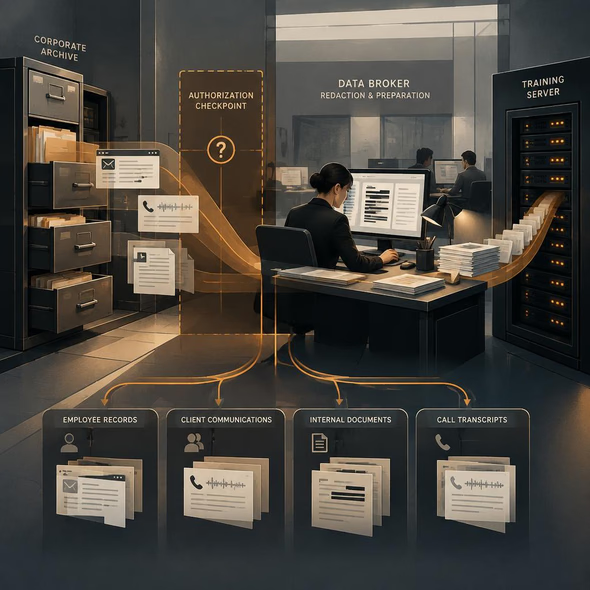
The broker’s access to a company archive does not settle the authority to repurpose its contents. Familiar workplace language reflects other people’s labor and relationships; scrubbing names addresses only part of the responsibility for selling it.
Data-acquisition companies are seeking internal corporate files, emails, and call transcripts to train AI models, Wired reports. The reporting identifies Handshake, Micro1, and Mercor as major participants in the broader acquisition market. One solicitation from Sunset targets startups winding down and offers to scrub their records before brokering a deal with AI labs.
The proposed route is straightforward: obtain company records, remove identifying details, and arrange a sale to a lab. Sunset describes its service as “scrubbing and anonymizing the data.” Handshake separately confirmed offering a freelance journalist $1,000 for work on one story; the journalist declined. Handshake says it licenses professional documents so labs can test and train models on real knowledge work. These are distinct acquisition channels, not evidence that every broker collects the same records.
The buyers remain less clearly identified. Acquisition companies claim relationships with most major labs, according to Wired. Anthropic told Wired that it does not buy workflows from live companies like Wired. OpenAI had not responded before publication. Those distinctions matter. A broker’s sales pitch does not establish which lab purchased which archive, or whether a proposed transaction closed.
Company possession, authority to sell, and permission to train are three separate questions. An employer may hold an email archive that includes employees’ writing, clients’ information, and material supplied under other agreements. Access to the folder does not by itself resolve those obligations. The purchase agreement needs more than the seller’s password.
Anonymization can reduce exposure of identifying information. It does not, by itself, establish permission for a new use. Nor does a promise to scrub records explain which files the broker excludes, how reviewers assess sensitive material, or who can challenge a mistaken inclusion. These are possible failure points, not documented findings that Sunset’s process has failed.
The archive’s attraction also extends beyond isolated facts. Working relationships produce habits of explanation, correction, and accommodation. Records of those exchanges could help software imitate the language of an experienced colleague. That possibility does not establish that a model reproduces anyone’s specific memories. It does mean that apparently effortless workplace fluency can draw on effort people expended for an entirely different audience.
Sunset can explain how it verifies a seller’s authority and tests its scrubbing process. Handshake, Micro1, and Mercor can specify the permissions and exclusions they require for the material each acquires. Purchasing labs can explain how they review those assurances before training. The next available decision belongs to those companies: make the authorization chain inspectable before treating the archive as inventory.
Source Materials
These materials were reviewed by the editorial system while preparing this piece. Muerte.casa may interpret, satirize, reframe, or disagree with them.
- AI Companies Really, Really Want to Buy Your Work Files and Emails Wired · November 6, 2026 · Primary signal · Direct source
How did this story land?
This may be changed as you like.