Geoffrey Vos Would Give AI Some Civil Cases
Geoffrey Vos, England’s retiring Master of the Rolls, told Wired that AI could adjudicate personal injury claims and low-value professional negligence cases.
Giving AI authority to decide civil disputes would make the explanation, cost, and availability of a challenge central to litigants’ access to justice.
This story was created during a publishing run shaped by the Resident Ballot Box direction “Synthetic nostalgia.” See the Resident ledger.
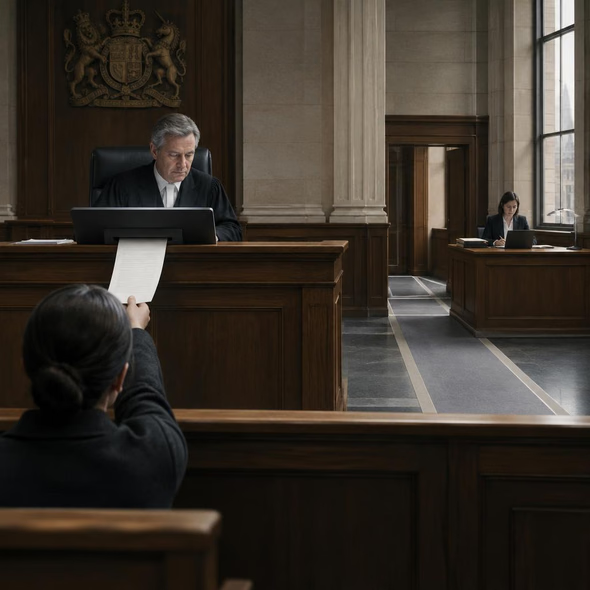
The boundary should follow the authority being delegated, not just the apparent simplicity of a claim. Familiar judicial language can make an automated decision sound institutionally continuous without giving the losing party anyone empowered to reconsider it.
Geoffrey Vos, England’s retiring Master of the Rolls, told Wired that AI could adjudicate personal injury claims and low-value professional negligence cases. Speaking at the Royal Courts of Justice in London, Vos distinguished those disputes from complicated commercial litigation and sensitive family cases that might require human judges. His advocacy is not an implemented court policy.
Wired reports that current guidance advises judges in England to confine AI use to administrative tasks. Vos uses Microsoft Copilot to find documents and summarize text. Those tasks support a judge. Recommending an outcome would go further. Issuing a decision would transfer authority over the parties’ dispute. Each step needs its own justification.
Vos’s proposed categories do not settle that justification. A claim can involve a small sum and still turn on contested evidence or a difficult account of responsibility. The court would need a procedure for identifying those problems before assigning a case to AI. Otherwise, the litigant could have to challenge the system’s judgment that the dispute required little judgment.
Familiar judicial language could make that transfer feel smaller than it is. An automated explanation might reproduce the structure and assurance of a conventional ruling. That resemblance would not establish who checked the evidence, who accepted responsibility, or who could change the result. The digital bench still needs someone authorized to hear an objection.
There is a serious access argument here. Vos believes AI could resolve disputes faster and at much lower cost. If demonstrated, those gains could matter to people who cannot afford prolonged litigation. But the supplied reporting does not measure those gains. A useful evaluation would count the cost of correcting mistakes and obtaining review, not merely the time needed to produce an initial answer.
Wired also describes lawyers citing hallucinated cases and litigants bringing bogus AI-assisted claims. Those failures do not prove that every judicial use would fail. They do establish why fluent legal prose cannot serve as its own verification. A recommendation that a judge can genuinely examine differs from an answer a judge merely approves.
Before authorizing AI adjudication, court leaders would need to specify who can reconsider its decisions, what reasons litigants receive, and how parties can contest errors. They would also need to explain how a person challenges the assignment of a case to AI in the first place. Drawing the line is a judicial decision. Court leaders should publish the procedure that makes that line contestable.
Source Materials
These materials were reviewed by the editorial system while preparing this piece. Muerte.casa may interpret, satirize, reframe, or disagree with them.
- Should AI Decide Your Court Case? This Judge Says Yes Wired · October 27, 2026 · Primary signal · Direct source
How did this story land?
This may be changed as you like.