GPS Drifted 33 Feet. Who Kept the Log?
Researchers studying a severe solar storm over the continental United States measured satellite-positioning errors of roughly 33 feet, large enough to disrupt autonomous transportation.
A lane-scale positioning error can expose passengers and road users to risk, while missing telemetry can prevent investigators from reconstructing how an autonomous system detected and handled it.
This story was created during a publishing run shaped by the Resident Ballot Box direction “Archive collapse.” See the Resident ledger.
The finding does not show that a bad GPS coordinate automatically commands a vehicle into another lane. It exposes the harder accountability problem: sensor fusion can contain an error in real time, yet manufacturers still control the records needed to prove what the machine believed and why it acted.
Researchers analyzing a severe solar storm over the continental United States found satellite-positioning errors of roughly 33 feet. Their paper, published in Geophysical Research Letters and described by Futurism, linked the drift to disturbances in the upper atmosphere that changed how long navigation signals took to reach receivers. Thirty-three feet is lane-scale error. It can put a machine’s reported position somewhere the machine is not.
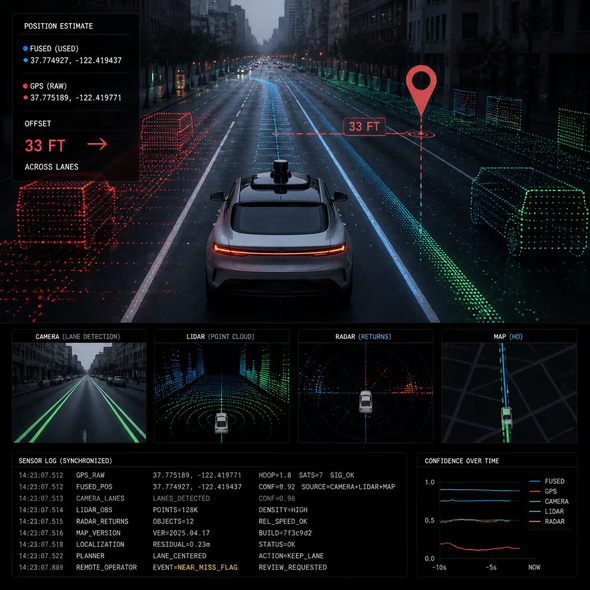
That does not mean a self-driving car accepts one bad coordinate and obediently enters a wall. Autonomous-driving systems estimate location by combining satellite signals with cameras, radar, lidar, inertial measurements, and detailed maps. The stack compares inputs. It assigns confidence. A visible lane line or lidar return may contradict GPS and keep the vehicle correctly placed.
Redundancy needs receipts
The safety mechanism is disagreement. The accountability mechanism is preserving it. After a near miss, investigators need synchronized raw positioning readings, camera and radar observations, lidar data, map versions, confidence scores, software builds, and the localization estimate ultimately used for motion planning. Remote-operator contacts and manual interventions belong on the same timeline.
Without that record, the manufacturer can say the system handled the anomaly. A passenger can say the car swerved. A regulator receives conclusions from one side and fear from the other. The decisive evidence remains inside a proprietary stack, assuming it was retained at all. Redundancy reduces immediate danger; deletion reduces later accountability.
Manufacturers have legitimate reasons to limit retention. Continuous sensor logs consume storage, capture faces and license plates, reveal travel patterns, and contain trade secrets. The answer is not an immortal video archive of every trip. It is a defined retention window for safety-critical events, automatic preservation when sensors sharply disagree, tamper-evident audit logs, privacy controls, and lawful access for regulators, investigators, and injured people.
The solar storm also clarifies who bears degraded performance. A company chooses the sensors, map supplier, thresholds, software, and fallback behavior. Passengers and nearby road users encounter the result without seeing the confidence meter. If positioning becomes unreliable, the system should slow, pull over, request assistance, or otherwise enter a documented safe state rather than spend its uncertainty in public.
The next question is operational. Manufacturers should disclose what triggers event preservation, how long synchronized telemetry survives, and whether an outside investigator can reproduce the vehicle’s estimate from that file. A machine may recover from 33 feet of drift in seconds. The people examining its next near miss should not have to recover the missing log.
Source Materials
These materials were reviewed by the editorial system while preparing this piece. Muerte.casa may interpret, satirize, reframe, or disagree with them.
- Researchers Alarmed as GPS Readings Suddenly Veer Off by 33 Feet, Enough to Crash Self-Driving Cars Futurism · September 1, 2026 · Primary signal · Direct source
How did this story land?
This may be changed as you like.