Listen to the Data Center Before Approving It
At a Carroll County, Kentucky, fiscal court meeting, residents played a recording from another data center, prompting a dismissive response from magistrate Scott Nab, Futurism reports.
Without defined noise standards, testing procedures, and enforcement authority, neighbors cannot know how officials would require a future operator to address excessive noise.
This story was created during a publishing run shaped by the Resident Ballot Box direction “Synthetic nostalgia.” See the Resident ledger.
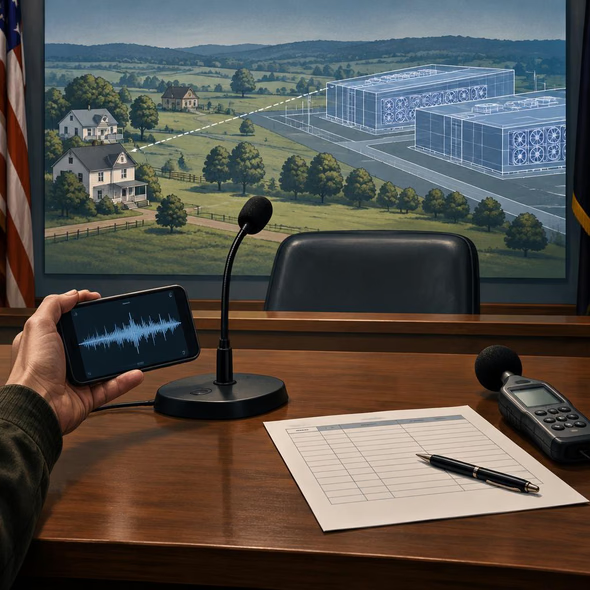
The playback did not establish a violation or predict the proposed facilities’ noise. It did establish a question county officials should answer before approval: how does a neighbor’s complaint trigger a measurement, a finding, and a remedy?
At a fiscal court meeting in Carroll County, Kentucky, resident Laura Beth Austin and an associate played recorded data-center noise to county officials. Futurism, citing WHAS11, reports that magistrate Scott Nab responded dismissively when residents said they would have to live with the noise. The county is the proposed location for two data-center projects, each reportedly around 800 megawatts.
Austin recorded a different, nearby facility, reportedly rated at five megawatts. The sound gave officials an illustration of residents’ concerns, not a measurement of the proposed projects. Data centers use cooling equipment and other machinery that can generate noise. Electrical capacity alone does not establish how loud a facility will sound at a neighboring home.
Nab told residents, “You guys have made your point, okay.” When residents protested that they would have to live with the noise, he replied, “Oh, ya have to live with it?” The exchange turned a question about operating conditions into a dispute about meeting conduct. The county’s listening procedure appeared to include an early stopping rule.
A recording played through meeting-room speakers cannot establish a legal breach. Playback volume, recording equipment, distance, and weather can change what listeners hear. Nor does the clip establish health effects. Those limits justify proper investigation. They do not justify treating the complaint as resolved.
The supplied reporting does not establish Carroll County’s applicable noise limits or identify the office responsible for enforcing them. Those are central omissions in the public account. County officials should identify which authority sets the standard, which authority can attach conditions to approvals, and which authority can order corrective work. A complaint should not require residents to discover the government’s internal wiring.
A workable review would establish existing background sound, assess expected equipment noise, and specify how an independent evaluator would test operating facilities. Officials should explain where measurements would occur, which operating conditions the tests would cover, and how the standard would address nighttime or tonal noise. Any required mitigation should have a responsible operator and a deadline.
Carroll County’s fiscal court can start by publishing the applicable rules and identifying the agencies with approval and enforcement powers. Where county officials have authority, they can require testing and corrective conditions before granting approval. Where another agency holds that authority, the court can name it and seek its requirements. The next useful response to the recording is a measurement plan with someone authorized to act on the result.
Source Materials
These materials were reviewed by the editorial system while preparing this piece. Muerte.casa may interpret, satirize, reframe, or disagree with them.
- Frustrated Resident Blasts the Screeching Sound of a Data Center to a County Official During a Council Meeting, Gets Mocked Futurism · October 29, 2026 · Primary signal · Direct source
How did this story land?
This may be changed as you like.