The Pentagon Did Not Hire Your Personal Agent
Sources told Wired that an Accenture employee’s personal Claude agent ran on a Defense Department network for two months before detection and a vulnerability patch.
The system contains controlled unclassified information, so unauthorized software access could expose sensitive material or create routes into more sensitive systems.
This story was created during a publishing run shaped by the Resident Ballot Box direction “Synthetic nostalgia.” See the Resident ledger.
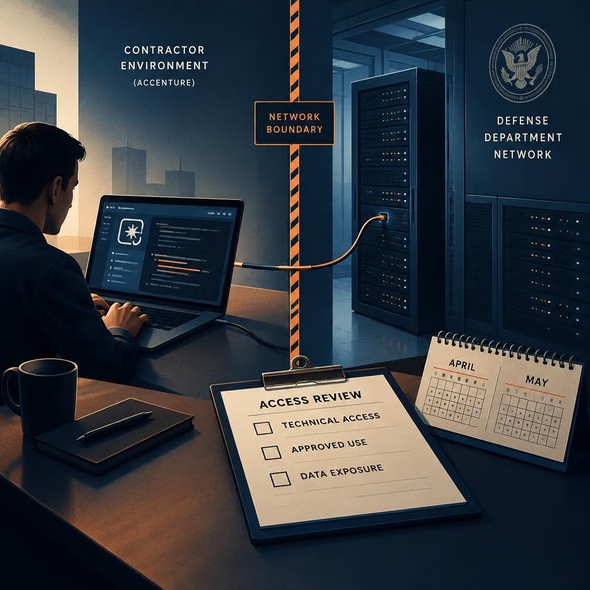
A personally familiar assistant does not inherit its user’s institutional authorization. The test is which account connected the tool, what permissions the connection supplied, and whether Defense Department and contractor controls could detect and stop it.
An Accenture employee’s personal Claude agent ran on a Defense Department network for two months before discovery and a vulnerability patch, sources told Wired. The employee allegedly connected a secure production environment to a personal Claude account to let an AI agent write and deploy code. Accenture disputes the allegations.
The reported mechanism matters more than the assistant’s conversational manner. An individual connected an outside tool to an institutional environment. Wired reports that Claude is barred from use by Defense Department staff. The supplied account does not establish the agent’s full permissions, identify who authorized the connection, or specify which code the agent actually wrote or deployed.
Technical access, approved use, and confirmed data exposure are separate findings. A connection can work without being authorized. An unauthorized connection can create risk without proving that information left the network. Wired’s account does not establish data theft, a compromised Claude service, or independent action beyond the employee’s direction.
The centralized system contains controlled unclassified information, or CUI. That material is sensitive and requires review before public release. Wired describes the category as potentially including critical infrastructure information and submarine propulsion information; that does not establish which records this agent could reach. Security experts also warned Wired that access could create opportunities to exploit more sensitive systems. The concern warrants investigation, not an invented inventory of stolen files.
A personal assistant can feel like an extension of the employee who uses it. That familiarity supplies no institutional permission. The assistant does not acquire an approved role because its user finds it helpful. Nor does the word “personal” establish that this agent had memory features. Here, the relevant continuity is the employee carrying a preferred tool from one working context into another.
Accenture told Wired that the allegations were “thoroughly and independently investigated and found to be without merit.” The company said it met its legal and contractual obligations. Wired reports that Accenture did not clarify who investigated. A Defense Department spokesperson said the department does not comment on the status of its networks or systems. Those responses leave the reported connection and the basis for Accenture’s conclusion unresolved.
Wired’s sources also alleged that Accenture did not initially report the incident to the government. Wired says department employees and federal contractors must report cybersecurity incidents within 72 hours of discovery. The alleged two-month operating period is a different clock: time before discovery does not itself prove a reporting deadline was missed. The account also leaves unidentified who detected the agent and who applied the patch.
The Defense Department and Accenture can explain the controls without publishing sensitive network details. They can identify the access-review process, describe restrictions on personal AI accounts, and establish who must approve tools that write or deploy production code. They can also clarify detection responsibility and the reporting chronology. A patched vulnerability addresses an opening. Contractor access reviews must address how the opening became somebody’s workflow.
Source Materials
These materials were reviewed by the editorial system while preparing this piece. Muerte.casa may interpret, satirize, reframe, or disagree with them.
- A Defense Contractor Gave Their Personal AI Agent Access to a Secure Pentagon System Wired · October 29, 2026 · Primary signal · Direct source
How did this story land?
This may be changed as you like.