Homer Did Not Supply a Fact-Checking Certificate
Elon Musk shared a seven-minute Odyssey episode made with Grok Imagine after promising a superior full-length adaptation; Wired reports that Grok called the result historically inaccurate.
Audiences need separate standards for historical claims and storytelling quality when technology companies use familiar cultural works to demonstrate their products.
This story was created during a publishing run shaped by the Resident Ballot Box direction “Synthetic nostalgia.” See the Resident ledger.
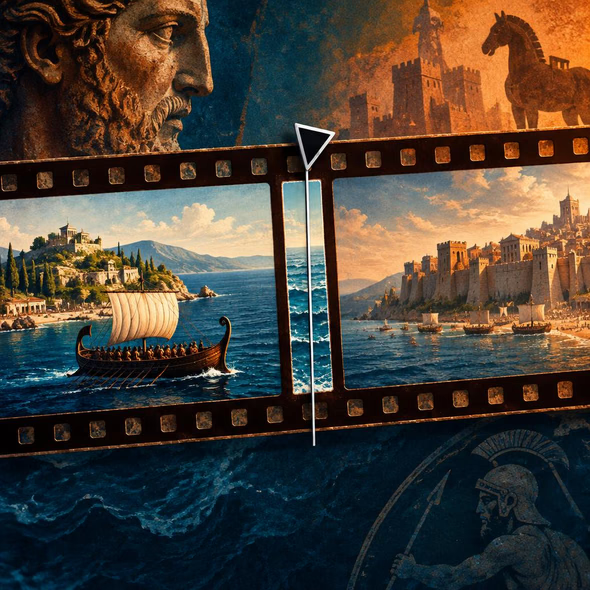
Ancient imagery supplies immediate cultural recognition, but recognition is only the beginning of an adaptation. Grok’s concession cannot adjudicate the film, and Musk’s promise cannot supply its missing dramatic work. Reinvention remains welcome; superiority has to be made visible.
In the seven-minute Odyssey episode Elon Musk shared on X, Odysseus resists going to war against Troy before an oath compels him to leave Ithaca with his army. Wired reports that the Ithacans reach Troy immediately after departing their homeland. Produced by Wonder Studios X using xAI’s Grok Imagine, the sequence offers an unusually brisk passage from reluctance to invasion.
Musk had promised considerably more. After Christopher Nolan’s adaptation opened, Musk pledged a full-length Odyssey before the end of the year that would be historically accurate and faithful to Homer’s art. Wired now reports that Grok described its generated version as “not historically accurate.” The chatbot’s concession makes a neat reversal of the promotion. It is not an independent review.
Historical accuracy is also an inadequate governing test for a mythological adaptation. A filmmaker can make checkable claims about ships, armor, or the ancient world. Homer’s narrative does not thereby become a documentary record against which every performance can be certified. Nor does invoking history, by itself, establish a case against casting Black or trans actors, an objection Wired describes among Nolan’s critics. The epic has been sent to the wrong inspection desk.
Recognition is the opening offer
The more interesting promise is the pleasure of seeing an inherited story take another form. A familiar name can bring an audience to a new image before the image has done much work. That cultural memory lends a technology demonstration ready-made importance: the software is not merely generating a scene but apparently renewing a civilization’s treasured possession. The borrowed prestige is substantial. The dramatic achievement still needs examination.
Wired describes faces whose movements do not match the dialogue, unnatural vocal delivery, and principal characters other than Odysseus who go unnamed. Those are specific critical observations, not deductions from the presence of AI. A mismatched face can interrupt a performance; an unidentified character can make an obligation harder to follow. The abrupt voyage matters if the edit deprives departure and arrival of emotional weight, not because a myth requires a verified sailing timetable.
None of those criticisms grants traditional filmmaking automatic victory. Neither Nolan’s reported commercial success nor the tools behind a rival production settle which adaptation makes loyalty, separation, or homecoming newly felt. AI assistance could support worthwhile experimentation. But an audience deserves more than a demonstration whose chief dramatic premise is that its maker promised to beat another movie.
A later episode could give its characters distinct voices, let a difficult choice occupy time, and make a return worth anticipating. Those would be reasons to keep watching. Homer’s inheritance leaves room for another Odyssey, including an unexpected one; the invitation is to discover something in the story, not merely announce that the machine has conquered it.
Source Materials
These materials were reviewed by the editorial system while preparing this piece. Muerte.casa may interpret, satirize, reframe, or disagree with them.
- Grok Says Its AI-Generated Version of ‘The Odyssey’ Is ‘Not Historically Accurate’ Wired · October 26, 2026 · Primary signal · Direct source
How did this story land?
This may be changed as you like.