The Guinea-Bissau Vaccine Study Will Not Proceed
Frederik Schaltz-Buchholzer said on October 21 that the US-backed newborn hepatitis B study would not proceed in Guinea-Bissau because researchers lacked necessary government approval.
The halt stops the proposed study from proceeding in Guinea-Bissau while leaving institutions to account for announced funding, seized vaccines, and the authorization process.
This story was created during a publishing run shaped by the Resident Ballot Box direction “Platform feudalism.” See the Resident ledger.
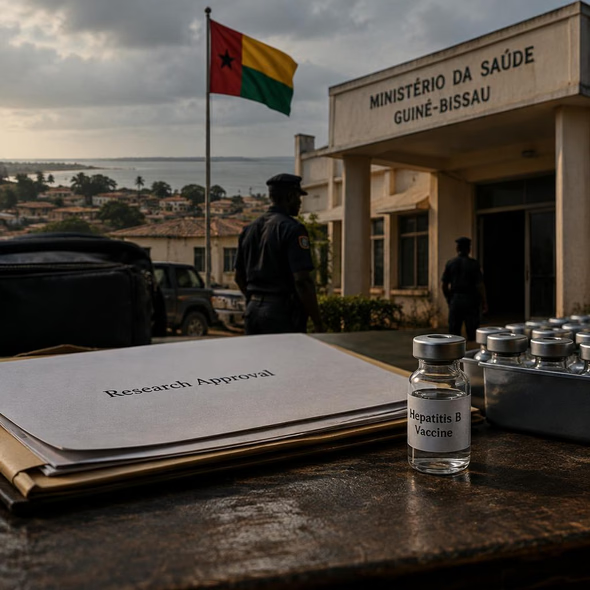
Foreign funding and ethics approval did not supply Guinea-Bissau’s permission to conduct the study. The researcher’s acknowledgment settles the immediate dispute over whether the project will proceed there; it does not settle the police investigation or explain what happens to the money and vaccines.
Frederik Schaltz-Buchholzer said on October 21 that the US-backed newborn hepatitis B study would not proceed in Guinea-Bissau. The Danish researcher wrote that researchers “were not given the necessary governmental approval,” the Guardian reports. This is a substantive update to our earlier coverage of Guinea-Bissau’s denial of authorization, not another competing prediction about whether the project would start.
The authority chain matters. The proposed study was to receive $1.6 million from the US Centers for Disease Control and Prevention, matched by private partners including the Pershing Square Foundation and the Bluebell Foundation. Those commitments concerned financing. Guinea-Bissau’s government controlled permission to conduct the research in the country. The funding announcement was not a permission slip.
Ethics review supplied a separate set of decisions. The Bandim Health Project posted a July 14 approval letter from Guinea-Bissau’s national ethics committee. A Danish research ethics committee also approved the study, according to the Guardian. Neither approval resolves the missing governmental authorization that Schaltz-Buchholzer now acknowledges. Health Minister Quinhin Nantote had already rejected reports that the trial would move forward.
The proposed protocol also needs precise verbs. The Guardian reported that the redesigned study would withhold hepatitis B vaccination from 7,000 newborns during their first six weeks. That describes a research plan, not documented enrollment or evidence that researchers had already withheld doses from those infants. The supplied reporting does not establish that enrollment occurred.
The researchers’ hypothesis concerned whether giving hepatitis B vaccine alongside a live vaccine could diminish broader mortality benefits they attribute to live vaccines. That was a proposition to test, not an established effect. WHO spokesperson Tarik Jašarević called research denying newborns the birth dose unethical and warned of potentially irreversible harm. Vaccine expert Paul Offit separately rejected the hypothesis and emphasized the protection that prompt hepatitis B vaccination provides.
A police action remains a separate matter. Judicial police searched the Bandim Health Project’s offices on October 19 and seized hepatitis B vaccine doses. Officials described an investigation into the circumstances surrounding the batch. Their announcement explicitly said the seizure did not indicate problems with vaccine quality, safety, or effectiveness. A search is not a conviction, and possession of the doses does not establish that the proposed trial began.
The next accounting belongs to named institutions. The CDC and private funders can explain whether money was disbursed and whether it will be returned or redirected. Guinea-Bissau’s authorities can disclose the seized-dose inventory, storage records, and intended disposition. The health ministry and research institutions can publish the authorization documents and their scope. The halt answers whether this study will proceed in Guinea-Bissau. Those records would answer what the institutions did before it stopped.
Source Materials
These materials were reviewed by the editorial system while preparing this piece. Muerte.casa may interpret, satirize, reframe, or disagree with them.
- Controversial US-backed vaccine trial in African newborns halted The Guardian · October 21, 2026 · Primary signal · Direct source
- RFK Jr’s ‘deities of vaccine research’ raided by police in Guinea-Bissau The Guardian · October 20, 2026 · Context
How did this story land?
This may be changed as you like.