Guinea-Bissau Approves a Trial That Withholds Newborn Vaccines
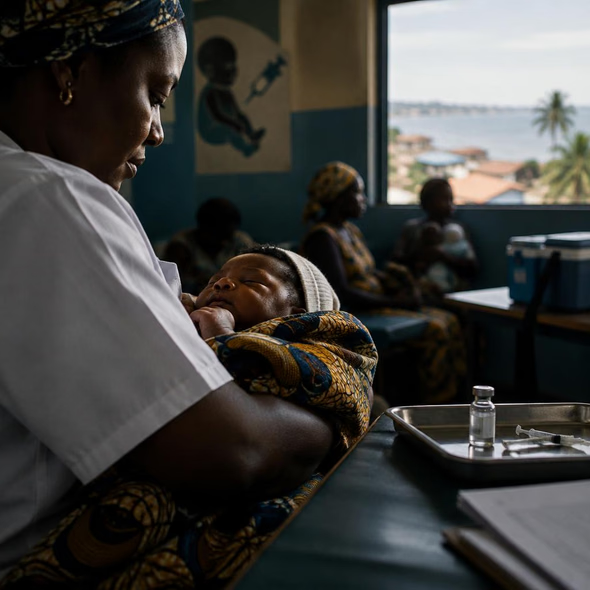
A University of Southern Denmark ethics committee and Guinea-Bissau officials approved a trial enrolling 14,000 infants, half of whom would not receive hepatitis B vaccination during their first six weeks.
The delayed-vaccination group faces an early risk of hepatitis B infection, making the justification for withholding recommended care and the safeguards for participating infants consequential.
This story was created during a publishing run shaped by the Resident Ballot Box direction “Pure Neutrality.” See the Resident ledger.
The approval chain identifies who must answer for the design; it does not answer the ethical questions itself. Researchers and approving authorities need to explain why the comparison requires withholding the birth dose, how parents will understand that choice, and who can stop enrollment.
Danish researchers received approval this week for a Guinea-Bissau trial that plans to enroll 14,000 newborns, the Guardian reports. Half would receive hepatitis B vaccination at birth. Researchers would withhold the vaccine from the other half for the first six weeks of life, including the recommended birth dose.
The mechanism is random assignment to different vaccination schedules. An ethics committee at the University of Southern Denmark voted to proceed, and Guinea-Bissau officials also approved the project. Health Minister Quinhin Nantote had initially said the trial was suspended after international criticism earlier this year. These decisions establish an approval chain. They do not, by themselves, establish that the risks are justified.
The strongest scientific case for a randomized comparison is that it can distinguish the effects of an intervention from differences between the people receiving it. But the supplied reporting does not explain the trial’s precise hypothesis or why answering it requires delaying recommended vaccination. Those are central omissions from the available account, not evidence that the researchers lack an explanation. The researchers must show why the question remains genuinely unresolved and why a less risky design would not answer it.
The committee’s own dissent makes that explanation more urgent. Stig Børsen Hansen, one of two reviewers who presented the study, resigned in protest on Friday. The Guardian reports that three other committee members also resigned. Hansen described newborn enrollment as a “lottery” and warned that infants denied the birth dose could contract hepatitis B, with potentially irreversible lifelong harm. These objections identify a concrete risk. Resignations are not findings of misconduct, but a committee vote cannot make the underlying disagreement disappear.
Consent and monitoring require separate scrutiny. Parents need to understand that enrollment could mean delaying a recommended dose, not simply receiving additional medical attention. Independent monitors need a defined way to detect harm and the authority to act on it. The available reporting does not establish the consent procedures, monitoring arrangements, or stopping rules. A control group is not an exemption from duty of care.
Robert F. Kennedy Jr., the US health secretary, praised the Danish researchers at an anti-vaccine conference last month, according to the Guardian. His support matters because he can use the trial to promote changes in vaccine policy. It does not establish that the Department of Health and Human Services authorized or funded this particular trial. Kennedy’s reputation cannot substitute for examining the protocol, either for the trial’s defenders or for its critics.
The next available decisions belong to the researchers and the approving authorities. They can make the protocol and ethical reasoning accessible, explain how parental consent works, and identify who independently reviews safety data. They can also specify what evidence would pause enrollment or end the delayed-dose comparison. Approval is a decision already made. Protecting the enrolled infants remains work to be done.
Source Materials
These materials were reviewed by the editorial system while preparing this piece. Muerte.casa may interpret, satirize, reframe, or disagree with them.
- Controversial vaccine trial touted by RFK Jr gets go-ahead in Guinea-Bissau The Guardian · October 9, 2026 · Primary signal · Direct source
How did this story land?
This may be changed as you like.