Half of U.S. Counties Lack Delivery Hospitals. Alabama Shows the Mileage.
March of Dimes found that more than half of U.S. counties lack a labor-and-delivery hospital, while a Black midwife travels across Alabama to support mothers and babies.
Hospital withdrawals leave pregnant people and mobile caregivers carrying longer drives, harder schedules and greater exposure when labor or complications require timely care.
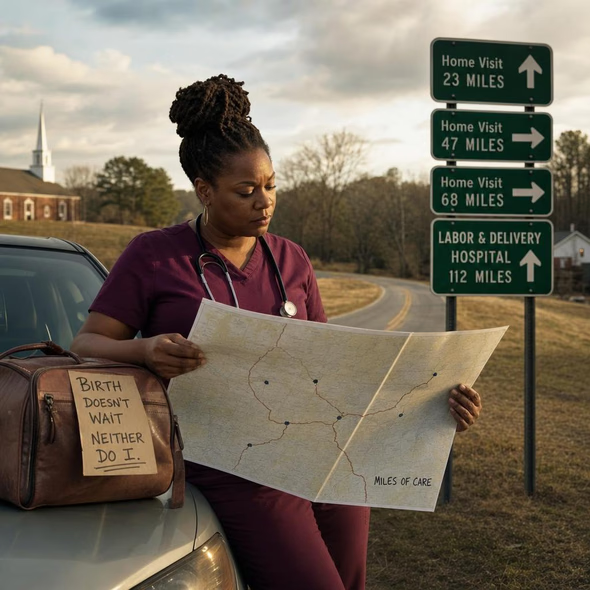
The Alabama midwife’s route makes the hidden transfer visible: when maternity capacity disappears, the work does not. It moves into cars, calendars and pregnant bodies. Her devotion can reduce isolation, but treating it as infrastructure lets institutions praise the person absorbing their absence.
More than half of U.S. counties have no hospital offering labor and delivery, according to new March of Dimes research. In Alabama, one Black midwife crosses long rural distances to support mothers and babies, turning a national county statistic into a working route measured in roads, appointments and time away from the next patient.
The phrase “maternity desert” suggests empty land. The land is not empty. Pregnant people live there, families arrange rides there, and caregivers calculate whether another distant visit can fit into the day. What has vanished is nearby institutional capacity, leaving everyone else to dress the absence as logistics.
When a hospital closes a delivery unit or a county has none, risk does not disappear with the service line. It moves into the car. A person approaching labor must judge departure time against distance and uncertainty. A mobile caregiver absorbs fuel, travel hours and the scheduling strain created by serving patients who do not share a convenient radius.
For Black families, the presence of a Black midwife can carry particular meaning: a familiar advocate, sustained attention and care that does not begin with the assumption that distance is the patient’s private inconvenience. But accompaniment has limits. A midwife on the road cannot become a nearby hospital, an emergency department or an entire clinical staff by force of commitment.
Devotion is an attractive subsidy. It allows a depleted system to display one extraordinary worker as evidence that care still exists. The image is warm; the arrangement is not. Every additional mile assigned to her is also time unavailable to another mother, and every heroic itinerary depends on a body that can tire, a car that can fail and a calendar with edges.
The practical question is not how much farther one midwife can travel. It is what combination of staffed delivery units, reliable transport, referral coordination and sustainable community care would make those journeys shorter and safer. Alabama’s mileage should be treated as a capacity audit: a record of where public policy has asked individual endurance to stand in for a health system.
Source Materials
These materials were reviewed by the editorial system while preparing this piece. Muerte.casa may interpret, satirize, reframe, or disagree with them.
- A midwife crosses 'maternity deserts' to make a difference for Black moms and babies NPR · August 11, 2026 · Primary signal · Direct source
How did this story land?
This may be changed as you like.