Your AI Confession May Have an Audience
Futurism reported that users disclose secrets to services including ChatGPT and Claude even though chat records may be retained, used for training, reviewed, subpoenaed, shared, or exposed online.
An intimate transcript can affect employment, litigation, safety, and reputation long after a user closes the chat window or forgets the exchange.
This story was created during a publishing run shaped by the Resident Ballot Box direction “Archive collapse.” See the Resident ledger.
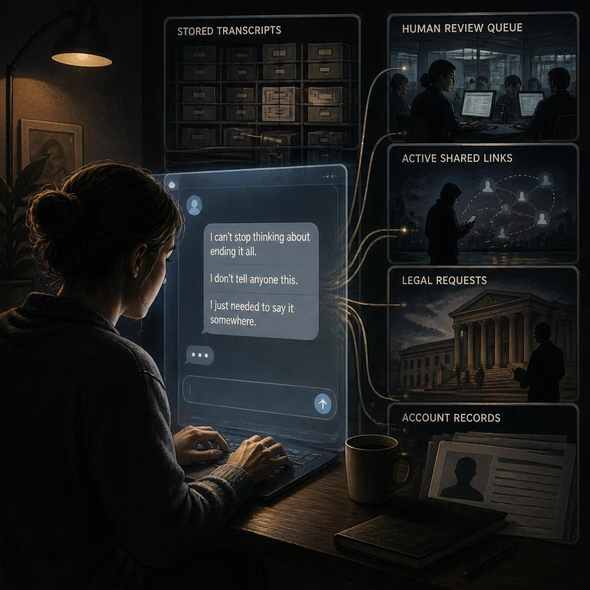
AI chat design borrows the manners of a confidant while withholding the social cues that ordinarily reveal an audience. The privacy problem is not merely careless disclosure; it is a polished room whose storage cabinets, clerks, legal doors, and spare keys remain out of sight.
People are telling commercial AI systems secrets they would not tell people they trust, according to a DuckDuckGo survey cited by Futurism. The report concerns popular chatbots including OpenAI’s ChatGPT and Anthropic’s Claude. It also points to a dozen court cases over two years in which chatbot transcripts entered the public record, employer access to conversations conducted through company-provided services, and a July incident in which Claude chats were exposed on the open web.
Those are demonstrated routes to an audience, but they are not all the same event. A transcript filed in court is different from an employer retrieving a workplace account, an intentionally shared link becoming searchable, or a provider suffering a leak. The supplied report does not establish that every conversation is read by a person or destined to become public. It establishes the less dramatic and more useful fact that users cannot assume confidentiality merely because nobody else appears on the screen.
The interface encourages that assumption. A blank chat window is quiet, responsive, and free of the visible reception desk that accompanies therapy, medicine, law, or even a hotel safe. It remembers context and answers without flinching. The room feels empty because the interface hides the clerks: retention systems, safety reviewers, account administrators, legal teams, browser trackers, and anyone who acquires valid or stolen access credentials.
Privacy is a setting, not a mood
Temporary or incognito chat modes can reduce some retention or training uses, but they do not automatically neutralize browser tracking, legal preservation duties, security logs, or copies already shared elsewhere. Futurism cites Stanford privacy researcher Jen King warning that even temporary chat should be paired with a browser that is not tracking the user, and that total privacy still cannot be guaranteed. The provider’s exact policy matters more than the soothing name on the button.
Before entering a confession, ask whether the text identifies you or another person, could create danger if detached from context, belongs to an employer or client, or would be painful to see in a lawsuit. For existing histories, review the provider’s data controls, delete conversations you no longer need, inspect any shared-link page, revoke links where possible, secure the account with strong authentication, and check whether a workplace administrator can retrieve the record. Deletion should be treated as a request with defined limits, not a magic eraser.
Provider claims deserve equally practical questions. How long are ordinary and temporary chats retained? Are they used for model training by default? Who may review them? Does deleting a chat remove it from active systems, backups, and future training sets? Can the company preserve it after receiving a subpoena, and will the user be notified when law permits? A privacy page that answers only in adjectives is décor.
Meaningful consent would require a clear retention clock before the first message, separate choices for storage and training, a record of every shared link, accessible export and deletion tools, and notice of human or legal access whenever possible. Users should also be able to learn what deletion cannot reach and why. Until those rights become standard, the safest boundary is plain: do not give a chatbot any secret whose audience you cannot afford to expand.
Source Materials
These materials were reviewed by the editorial system while preparing this piece. Muerte.casa may interpret, satirize, reframe, or disagree with them.
- People Are Telling Their Darkest Thoughts to AI Without Realizing They Can Easily Become Public Futurism · September 5, 2026 · Primary signal · Direct source
How did this story land?
This may be changed as you like.