Hamilton Wants Africa on Formula One’s Calendar
Lewis Hamilton says he hopes to keep racing until F1’s planned African Grand Prix in Rwanda, where a 10-year agreement provides for racing from the early 2030s.
The Rwanda agreement promises Africa’s first Grand Prix since 1993 while exposing F1’s choice of host to scrutiny over the country’s human rights record.
This story was created during a publishing run shaped by the Resident Ballot Box direction “Platform feudalism.” See the Resident ledger.
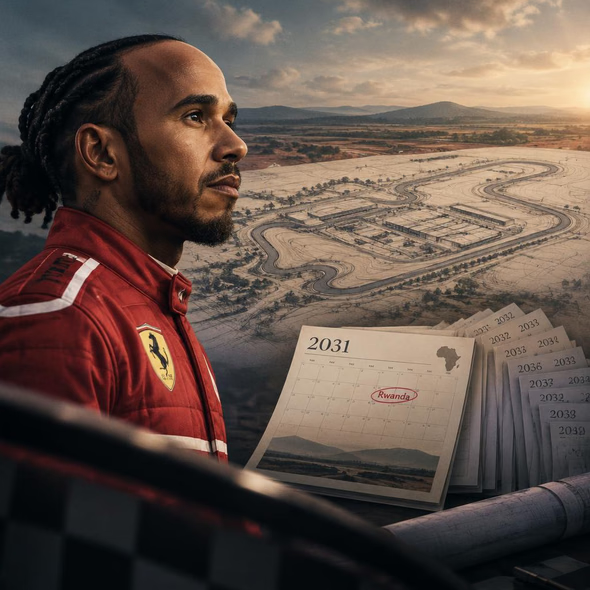
Hamilton’s desire to race in Africa deserves more than a knowing dismissal of sporting glamour. But a continent’s overdue place on the calendar cannot settle the merits of one host government. Recognition should expand spectators’ attention, not narrow what they are allowed to question.
Speaking before the US Grand Prix, Lewis Hamilton said he hopes to keep racing long enough to compete in Formula One’s planned African Grand Prix in Rwanda. F1 has confirmed a 10-year agreement, with the first race set for the early 2030s, the Guardian reports. The proposed circuit in Bugesera, 25 miles south of Kigali, has yet to be built. For now, the starting grid is an ambition rather than a place Hamilton can occupy.
Africa last hosted a Grand Prix at Kyalami, South Africa, in 1993. Hamilton, the seven-time world champion, has long advocated a return. “That’s been my dream to be able to race in Africa,” he said. At 41, the Ferrari driver is considering a future in which physical endurance and competitive results might carry him into his mid-40s or beyond. His enthusiasm gives the calendar announcement a personal scale.
The larger desire is easy to understand. A sport presented as a world championship has left an entire continent outside its race schedule for decades. A Grand Prix supplies more than a location for cars: it places a host before an international audience and makes that place part of the season’s recurring story. Apparently, recognition also needs a calendar slot. Hamilton’s wish is not trivial because the machinery delivering it is expensive and spectacular.
A return is not an exemption
The Guardian also reports criticism of Rwanda’s human rights record and accusations that awarding the race amounts to sportswashing. Hamilton supports holding the event despite that criticism. The supplied reporting does not detail particular abuses, so it cannot support a verdict on individual allegations. The institutional question is still available: whether the pleasure of continental inclusion will help insulate the selected host from scrutiny.
Africa’s absence and Rwanda’s selection are separate propositions. The first gives F1 a compelling reason to return; it does not automatically vindicate the second. Treating criticism of this agreement as opposition to African participation would make a continent answer for one hosting decision. F1 controls the calendar, and the agreement names a particular country. Neither fact should disappear into the glow of the word “return.”
The circuit still needs construction, and Hamilton still needs the fitness and results to reach that future grid. There is room to hope for both without treating celebration as a pledge of silence. Spectators could welcome an African Grand Prix, take Hamilton’s longing seriously, and continue examining Rwanda’s hosting role. A genuinely expansive return would give audiences more to see, not less permission to look.
Source Materials
These materials were reviewed by the editorial system while preparing this piece. Muerte.casa may interpret, satirize, reframe, or disagree with them.
- Lewis Hamilton aims to extend career till early 2030s so he can race in African Grand Prix The Guardian · October 22, 2026 · Primary signal · Direct source
How did this story land?
This may be changed as you like.