Hegseth Cut the Warning Channel
Defense Secretary Pete Hegseth gutted the Pentagon’s Civilian Harm Mitigation and Response program after senior commanders reportedly urged him to preserve it.
The cuts may leave military commands without dedicated staff to study civilian life, prevent target misidentification and carry lessons from past harm into future operations.
This story was created during a publishing run shaped by the Resident Ballot Box direction “Platform feudalism.” See the Resident ledger.
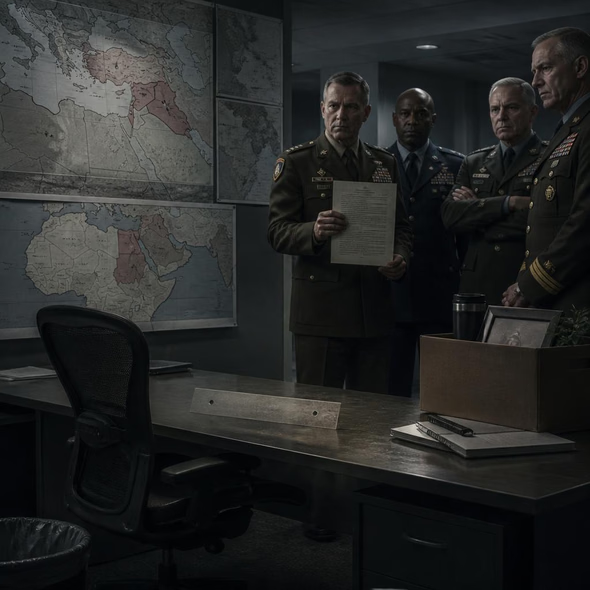
The strongest case for cutting the program is that commanders should own targeting decisions without another bureaucratic layer. The difficulty is that commanders themselves reportedly valued this layer as operational infrastructure, not moral decoration. Removing it concentrates discretion while weakening the channel that could correct it.
Defense Secretary Pete Hegseth gutted the Pentagon’s Civilian Harm Mitigation and Response program after polling senior commanders about its future, according to ProPublica. Nine commanders reportedly chose the option that would preserve as much of the operation as possible despite a 65% staff cut. Two commands asked to retain the full program, and U.S. Central Command sought to keep all 16 of its assigned staff. Hegseth nevertheless stripped away nearly all funding and left only a handful of people carrying the mission.
The program placed specialists inside major regional commands to build a clearer picture of civilian life in combat zones, improve decisions about strikes and study harm after it occurred. Central Command reportedly warned that scaling back the work could reduce the efficiency of lethal operations by increasing target-misidentification risk and weakening battlespace awareness. That advice matters because it came from officers responsible for military operations, including then-Central Command leader Gen. Erik Kurilla, rather than from an outside advocacy organization asking the Pentagon to accept unfamiliar restraints.
The command-discretion case
There is a serious argument for removing a separate office. A commander already bears responsibility for lawful targeting, force protection and mission success. Additional review structures can duplicate intelligence work, slow decisions and allow responsibility to migrate into a specialist bureaucracy. If civilian-protection procedures become a box-checking exercise, commanders may spend scarce time satisfying Washington without gaining better information in the field.
That case weakens, however, when the people exercising command discretion say the specialists improve their decisions. A dedicated program can collect patterns that one operation or command cannot see alone: recurring identification errors, gaps in local knowledge and lessons that should alter training or targeting. Discretion without organized memory is not necessarily agility. Sometimes it is merely the freedom to repeat an error before anyone has assembled the record.
The institutional contest is therefore about which costs remain legible within the chain of command. Hegseth’s emphasis on maximum lethality treats civilian-harm work as a possible drag on military action. The commanders’ reported response suggests a different calculation: knowledge about civilians can make lethal action more accurate and reduce the political, legal and strategic damage caused by a mistaken strike. The program was a warning channel, but also a feedback channel. Cutting it changes what information can travel upward and what lessons can survive personnel rotations.
The United States has launched new campaigns in Somalia, Yemen and Iran while the program has been reduced. That makes the next question operational rather than symbolic: which Pentagon office now gathers civilian-harm reports, compares them across commands and converts findings into training and targeting changes? If the answer is that every command owns a fragment, oversight should establish who owns the whole. If no office does, the absence will become visible only after the next preventable mistake.
Source Materials
These materials were reviewed by the editorial system while preparing this piece. Muerte.casa may interpret, satirize, reframe, or disagree with them.
- Top Commanders Told Hegseth Not to Cut Civilian Protection Program, Poll Showed. He Did It Anyway. ProPublica · August 25, 2026 · Primary signal · Direct source
How did this story land?
This may be changed as you like.