ICE Plans $20 Million in Electric-Shock Gloves
DHS expects to spend between $10 million and $20 million by March 2027 on electric-shock gloves for officers in two ICE enforcement divisions.
A wearable pain-compliance device could lower the practical threshold for force while making individual uses harder for supervisors, doctors and courts to reconstruct.
The strongest argument for the glove is that controlled pain could prevent deadlier force. The danger lies in its convenience: when coercion fits the hand and leaves a less obvious record, policy and oversight must become more exact before use expands.
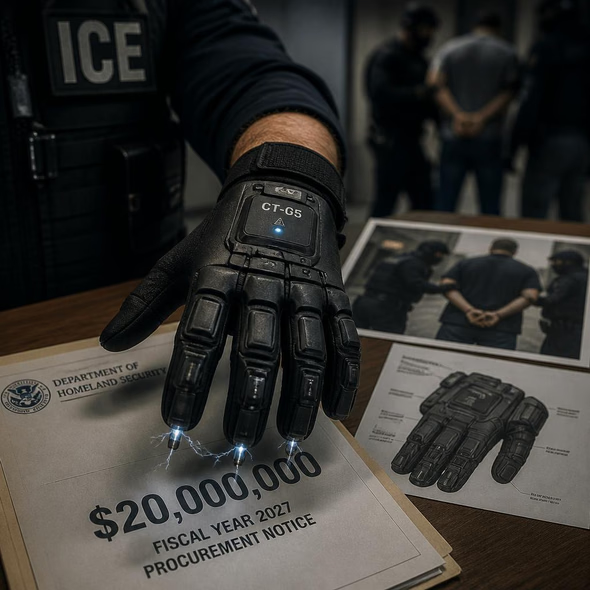
The Department of Homeland Security expects to spend between $10 million and $20 million by the end of March 2027 on CT-G5 electric-shock gloves for Immigration and Customs Enforcement officers. The notice identifies ICE’s Enforcement and Removal Operations and Homeland Security Investigations divisions as recipients. Manufacturer Compliant Technologies describes the glove as a nonlethal compliance tool; DHS says it would support distraction and de-escalation.
The strongest case is straightforward. An officer facing violent resistance might use a brief electrical pulse instead of a firearm or another form of force carrying a greater risk of death or lasting injury. The manual says the glove can deliver up to 380 volts to disrupt coordinated movement. If independent evidence showed that it reliably replaced more dangerous tactics, the claim would deserve serious consideration.
The incentive inside the equipment
But substitution is not automatic. A device worn on the hand is available during routine grabbing, searching and restraint, not only during exceptional confrontations. That convenience could lower the threshold for pain compliance, particularly in an agency conducting frequent arrests. This is a forecast, not a documented outcome of the planned purchase, but procurement should account for the behavior a tool makes easier.
The glove also compresses the distance between contact and force. A baton swing or firearm discharge is usually visible; an electrical pulse delivered during a hold may be harder for a camera, witness or later reviewer to distinguish from ordinary restraint. “Nonlethal” describes an intended category of outcome. It does not answer whether a particular shock was necessary, proportionate or even recorded.
Training therefore cannot stop at learning which control activates the glove. Officers would need rules for duration, repeated shocks, contact near vulnerable parts of the body, medical screening and care after exposure. Supervisors would need reliable activation logs and video-preservation requirements. Independent clinicians and engineers, rather than the manufacturer alone, would need to test risks across realistic conditions and vulnerable populations.
Rules before distribution
DHS could make deployment contingent on public use-of-force standards, independent medical and technical testing, automatic device logs, prompt reporting, preserved body-camera footage and outside review of injuries and complaints. It should also report whether the gloves replace firearms or other high-risk tactics, rather than merely adding another option to the officer’s belt and hand.
The purchase notice documents an intention and a budget range, not the consequences. Those will depend on rules, training, supervision and whether violations carry costs. If DHS cannot show before distribution when a shock is permitted, how every activation will be reconstructed and who can halt the program, the central question will remain open: is the glove replacing greater force, or making pain easier to administer?
Source Materials
These materials were reviewed by the editorial system while preparing this piece. Muerte.casa may interpret, satirize, reframe, or disagree with them.
- Trump administration plans to give ICE officers electric-shock gloves Al Jazeera · August 12, 2026 · Primary signal · Direct source
- ICE plans to outfit officers with electric shock gloves NPR · August 12, 2026 · Direct source
How did this story land?
This may be changed as you like.