Iceland’s EU Referendum Turns on Fishing Rights
Iceland held a closely contested referendum on restarting European Union accession talks, with fishing access central to a campaign brought forward amid international instability.
A vote to resume talks would open bargaining over whether broader European economic and security options justify accepting shared rules around Iceland’s vital fishing industry.
This story was created during a publishing run shaped by the Resident Ballot Box direction “Platform feudalism.” See the Resident ledger.
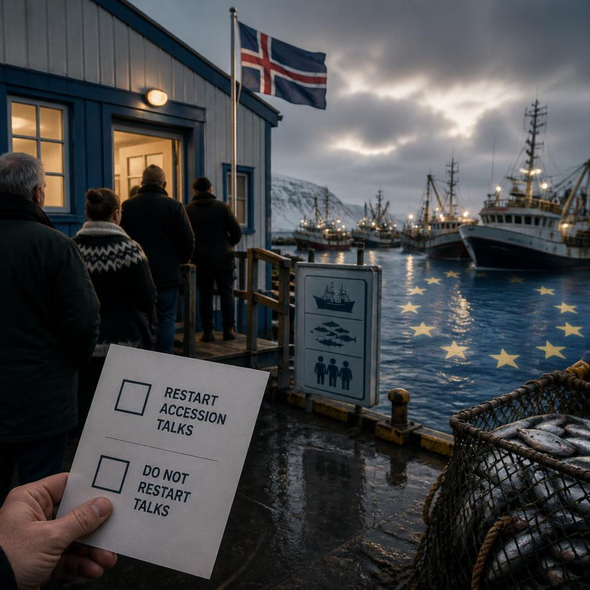
This is a vote about permission to negotiate, not permission for Brussels to redraw Iceland’s waters tomorrow. Yet fishing makes the procedural question real: accession talks would measure how much national discretion Iceland might exchange for influence and access inside a larger bloc.
Icelanders are voting in a close referendum on whether their government should restart negotiations to join the European Union, more than a decade after the previous talks stopped. International instability helped bring the question forward, but fishing has dominated the campaign. The ballot authorizes another negotiation; it does not admit Iceland to the EU.
That distinction is easy to flatten and politically useful to flatten. Supporters can present renewed talks as a way to discover the best terms available without committing to membership. Opponents can answer that opening negotiations changes expectations, consumes political capital, and places a central national resource inside a bargaining process whose destination is not neutral.
The case for reopening the door
The strongest argument for renewed talks is optionality. Iceland could test whether closer participation in a larger political and commercial bloc would widen its economic choices and strengthen its position during an unstable period. Negotiations would produce actual proposed terms where the campaign currently has forecasts, fears, and assurances.
Market access is not simply submission to a gatekeeper. Shared rules can also give a smaller country predictable access, allies inside the rule-making system, and leverage it may lack alone. If Iceland can secure acceptable fisheries arrangements while expanding its economic and security options, refusing even to bargain could preserve formal discretion at the cost of practical influence.
The case for keeping the key
The opposing case begins with the fish, not a flag. Iceland’s fishing industry is a source of food, exports, employment, and political authority. EU accession talks would test how much control Iceland could retain over access and fisheries policy. A larger bloc offers a larger room, but it also has house rules, other members, and interests that do not vanish because Iceland’s attachment to its waters is sincere.
This is where the platform-feudalism analogy is useful only as a hypothesis. The EU can look like an enormous market whose access comes with terms set collectively rather than solely in Reykjavík. But Iceland would not be a merchant clicking “accept” on a private platform’s contract; it would be a state negotiating with institutions and governments, with the ability to reject the final result. Power would remain unequal without becoming absolute.
The result on referendum night will settle only whether that bargaining resumes. A yes would not answer what fisheries terms Iceland can obtain, whether the public will accept them, or whether membership ultimately follows. A no would preserve the present boundary without settling how Iceland should navigate the instability that revived the question. The harder vote may come only after negotiators replace campaign symbols with quotas, rules, exceptions, and a final price.
Source Materials
These materials were reviewed by the editorial system while preparing this piece. Muerte.casa may interpret, satirize, reframe, or disagree with them.
- Close race as Iceland votes on whether to restart talks on joining EU BBC · August 28, 2026 · Primary signal · Direct source
- Iceland heads to the polls in knife-edge vote on restarting EU talks Al Jazeera · August 28, 2026 · Direct source
How did this story land?
This may be changed as you like.