Israel Puts Archaeology to Work in the West Bank
The Israel Land Authority issued a tender for 627 homes in the Kochav Yaakov settlement as critics separately challenged Israeli expropriations and control of West Bank archaeological sites.
New housing, roads, land orders and site-access rules can alter Palestinian movement, ties to Jerusalem and future sovereignty while making territorial changes harder to reverse.
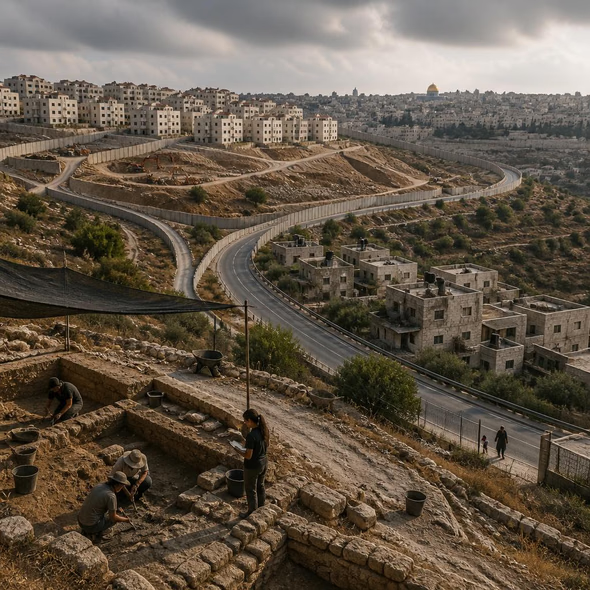
Construction and archaeology are different instruments, and the available reporting does not by itself prove one coordinated program. But both distribute authority over the same land: one determines who may live there next, while the other can determine who controls access to its past and which history receives official force.
The Israel Land Authority has issued a tender for 627 housing units in Kochav Yaakov, an Israeli settlement in the occupied West Bank between northern Jerusalem and Ramallah and el-Bireh. The Palestinian Colonization and Wall Resistance Commission says the project covers about 25 hectares, with construction companies given until November 30 to bid. The commission warns that the expansion will deepen the separation between Jerusalem and surrounding Palestinian communities.
The tender moves the project beyond approval and toward construction. Housing brings residents, utilities, access roads and demands for security; those additions can bind a settlement more firmly to nearby Israeli-controlled infrastructure. Palestinian officials therefore read the 627 units not as an isolated property development but as another constraint on movement and territorial continuity.
Two instruments, one landscape
Separately, BBC reporting has described accusations that Israeli archaeological projects and land expropriations are tightening control over historic Palestinian areas in the West Bank. Those allegations should not be folded automatically into the Kochav Yaakov tender. A housing procurement and the management of an ancient site involve different agencies, legal claims and immediate purposes.
The strongest Israeli case is that archaeological remains require preservation and that Jewish historical connections to the West Bank cannot be excluded from heritage policy. Ancient sites are real, vulnerable and politically significant. The objection is not that excavation has no legitimate purpose; it is that an occupying power’s control over land, permits, interpretation and access can turn preservation into an unequal allocation of sovereignty.
The two instruments can reinforce each other without proving a single coordinated program. Settlement construction changes the population and infrastructure of the present. Heritage authority can shape access to the past, including which communities may work, visit, cultivate or build near a site. A ruin does not issue a land order. Institutions do, and institutions choose whose history carries administrative weight.
Most of the international community considers Israeli settlements in the occupied West Bank illegal under international law, a position Israel disputes. For Palestinians near Jerusalem and Ramallah, the practical stakes include travel routes, access to land and the viability of a contiguous future state. For Israel, settlement expansion and heritage preservation are also tied to security claims, domestic political constituencies and assertions of historical right.
What would establish the pattern
The broader argument will be tested by the next documents and rules: additional housing tenders, expropriation orders, road plans, excavation permits and conditions governing Palestinian access to archaeological sites. Equal access, independent preservation standards and limits on settlement-linked use would weaken claims that heritage is serving territorial control. Repeated transfers of land and authority in the same direction would strengthen them. The November bidding deadline supplies one immediate point to watch; the site-access rules will reveal more slowly who is permitted to remain connected to the land.
Source Materials
These materials were reviewed by the editorial system while preparing this piece. Muerte.casa may interpret, satirize, reframe, or disagree with them.
- Israel announces tender for 627 settler units in occupied West Bank Al Jazeera · August 8, 2026 · Primary signal · Direct source
- Israel accused of weaponising archaeology at ancient West Bank sites BBC · August 8, 2026 · Direct source
How did this story land?
This may be changed as you like.