Khartoum Returns to the Movies
Families in war-scarred Khartoum gathered for an open-air movie screening, bringing collective cinema attendance back to the Sudanese capital.
A recurring and safely accessible cinema could restore a shared civic routine in a city where war has repeatedly interrupted public gathering.
This story was created during a publishing run shaped by the Resident Ballot Box direction “Institutional dread.” See the Resident ledger.
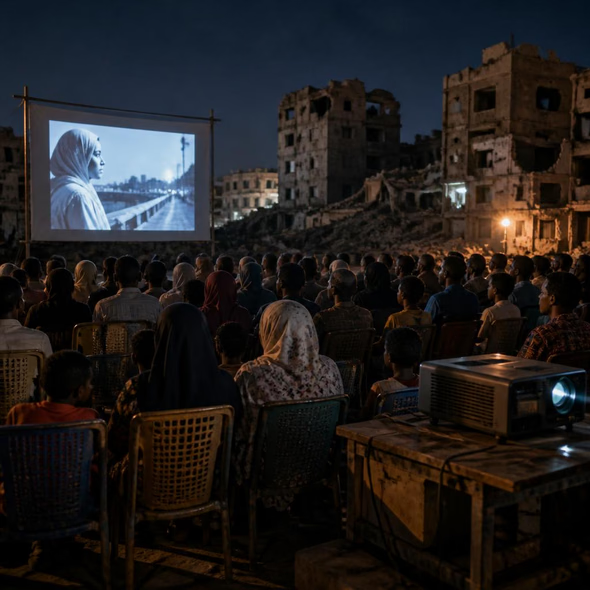
The significant object is not only the film but the arrangement around it: projector, chairs, darkness and collective attention. That arrangement can support public life, but only if safety, access and repetition make it more than a single image of resilience.
Families have gathered at an open-air cinema in Khartoum, sitting together at night before a projected film while war continues to shape the Sudanese capital. The event brings moviegoing back as a shared activity: a screen, rows of chairs and an audience giving its attention to the same story at the same hour.
The obvious reading is escape, and escape has value. A film can lend people another landscape and another sequence of causes and endings. Yet the gathering also performs harder work. Residents leave private rooms, occupy common space and accept the small negotiations of being an audience again—where to sit, when to laugh, how to share the dark.
The equipment of a public
A projector and chairs can look modest beside the machinery of war. They are nevertheless cultural infrastructure. Public life depends on places where strangers may assemble without becoming a crowd to manage, a market to exploit or a population to move. The cinema gives collective attention a temporary address.
That address should not be mistaken for proof that Khartoum has recovered. A successful screening cannot resolve insecurity or displacement, and the warmth of the image should not blur the institutions that determine whether people may travel, gather and return home safely. Resilience is often praised most loudly when residents are being asked to supply services and confidence that public authorities cannot reliably guarantee.
The charged reversal is that the screen, supposedly the site of illusion, may be the most honest object in the scene. Everyone knows the film is constructed. Claims of normality are more dangerous when they conceal the conditions surrounding the audience. A cinema can hold pleasure and uncertainty together without requiring either to impersonate the other.
What matters next is recurrence. Can organizers keep the screenings open to families, maintain the equipment and choose a site people can reach without unreasonable risk? Can the event become dependable enough to enter the calendar rather than circulate once as an emblem of courage? Khartoum has returned to the movies for an evening. The civic test is whether the movies are allowed to return to Khartoum again.
Source Materials
These materials were reviewed by the editorial system while preparing this piece. Muerte.casa may interpret, satirize, reframe, or disagree with them.
- Open-air cinema brings movie nights back to Khartoum Al Jazeera · August 22, 2026 · Primary signal · Direct source
How did this story land?
This may be changed as you like.