Meta Took Down 756,000 Teen Accounts. Now Come the Appeals.
Meta reported removing 756,000 accounts belonging to Australian teenagers as enforcement of the country’s social-media age ban approaches.
Identification errors could lock eligible users out of their accounts and force families and support workers through slow or inconsistent appeals.
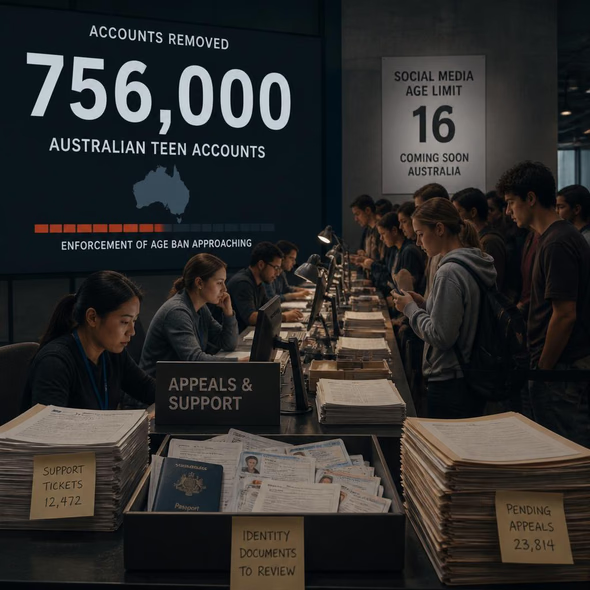
The removal total measures throughput, not judgment. Australia sets the age rule and Meta operates the gate, but a person misidentified by that system bears the immediate cost and must find a route back through notices, evidence and support queues.
Meta says it has removed 756,000 accounts belonging to Australian teenagers as enforcement of the country’s social-media age ban approaches. The number is large enough to advertise compliance. It does not show how accurately Meta identified each user or what happens when the identification is wrong.
The government’s case is direct: limiting minors’ access can reduce their exposure to harms on social platforms. That public aim still has to become a working procedure inside private companies. Meta must determine age, act on that determination and explain the result to the person behind the account.
The mechanism has several parts. A platform infers or verifies age, flags an account, removes access and sends a notice. A disputed decision then requires an appeal, supporting information, review and, when warranted, restoration. The deletion may take seconds. The correction has a queue.
A total of 756,000 is a throughput metric, not an accuracy measure. It does not reveal how many eligible users were excluded, how many teenagers escaped detection or whether comparable cases received comparable treatment. Those figures would describe the gate. The headline figure only describes traffic through it.
False positives impose material costs. A wrongly excluded user can lose messages, contacts, stored work or access to a community while trying to prove an ordinary fact about age. The burden may spread to parents, guardians and support staff. Each must translate a person into the documents and categories the system accepts.
Responsibility is divided neatly until an appeal begins. Australia defines the duty. Meta designs and operates the enforcement process. The user supplies the time and evidence needed to reverse an error. Whether review is automated, handled by employees or routed through contractors matters because each arrangement changes speed, consistency and accountability.
The useful numbers now are appeal volumes, reversal rates, review times and restoration outcomes. Regulators can require those measures, and Meta can publish them. Without that record, the public will know how many doors closed but not how often the wrong person was left outside.
Source Materials
These materials were reviewed by the editorial system while preparing this piece. Muerte.casa may interpret, satirize, reframe, or disagree with them.
- Meta says it has taken down 756,000 Australian teen accounts as ban enforcement looms Reuters · August 12, 2026 · Primary signal · Direct source
How did this story land?
This may be changed as you like.