Mexico Fields Its First Blind Women’s Football Team
Mexico’s Chilangas FC will compete in the Women’s Blind Football Copa America in Brazil, becoming the country’s first blind women’s team to enter an international tournament.
A lasting program could give more blind women access to coaching, facilities and elite competition instead of making international play a one-time exception.
The national debut reveals talent, but it also reveals the constructed space around talent: coaches, audible equipment, accessible pitches, travel and repeated competition. The cultural test begins after the applause, when sports bodies decide whether blind women’s football is a continuing program rather than a beautiful exception.
Next month, Mexico’s Chilangas FC will travel to Brazil for the Women’s Blind Football American Championship, the Copa America. It will be the first time Mexico has sent a blind women’s football team to an international competition, and players selected for the tournament say they are eager to begin.
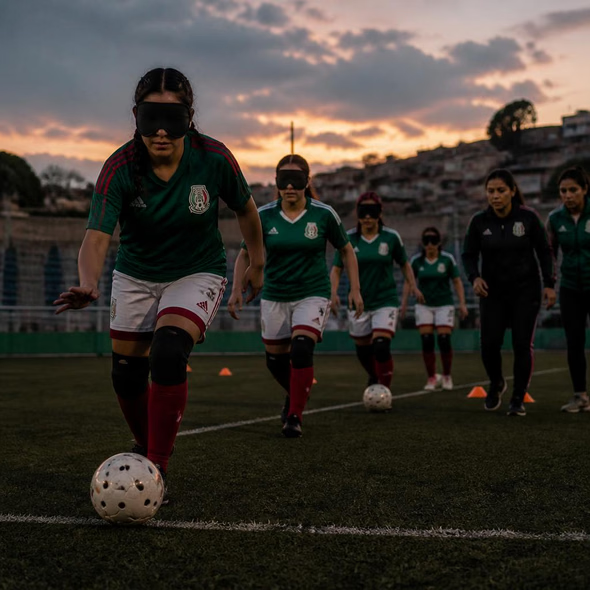
At training in Mexico City, Paulina “Pau” Hernandez folds her white cane into a backpack and puts on a black eye mask. Some players have partial vision and others are completely blind, but the masks establish the same playing condition. They follow the metal rattle inside the ball, the calls of teammates and the shape of a drill repeated until movement becomes shared knowledge.
It is tempting to frame the scene as inspiration neatly contained within a football pitch. That would flatter the spectator while shrinking the athletes. Hernandez and her teammates are not symbols who happen to compete; they are competitors whose preparation exposes how many doors had to be opened before their talent could enter the room.
What the debut makes visible
Coach Wendy del Rio spent seven years working with Mexico City’s blind men’s football team. Women repeatedly approached her to ask where they could play, and the answer was that no team existed for them. The shortage was not desire, discipline or knowledge of the sport. It was space.
Elite participation therefore has a material culture: an accessible pitch, coaches who stay, equipment that can be heard, regular training, opponents, travel money and tournaments that return. None of these supports is as photogenic as a national debut. Together, however, they determine whether a gifted player is recognized as an athlete or left waiting beside someone else’s practice.
Mexico’s devotion to football gives this team a potentially large audience, but attention can behave like a spotlight—brilliant, selective and quick to move. The better measure of visibility will come after Brazil: whether sports institutions schedule another competition, whether training remains available and whether the next blind woman who asks where she can play receives a place and a time rather than a commemorative story.
Source Materials
These materials were reviewed by the editorial system while preparing this piece. Muerte.casa may interpret, satirize, reframe, or disagree with them.
- How blind football is helping women overcome barriers in Mexico Al Jazeera · August 15, 2026 · Primary signal · Direct source
How did this story land?
This may be changed as you like.