A Larger Police Force Will Not Fix Middlesbrough’s Silent Phone
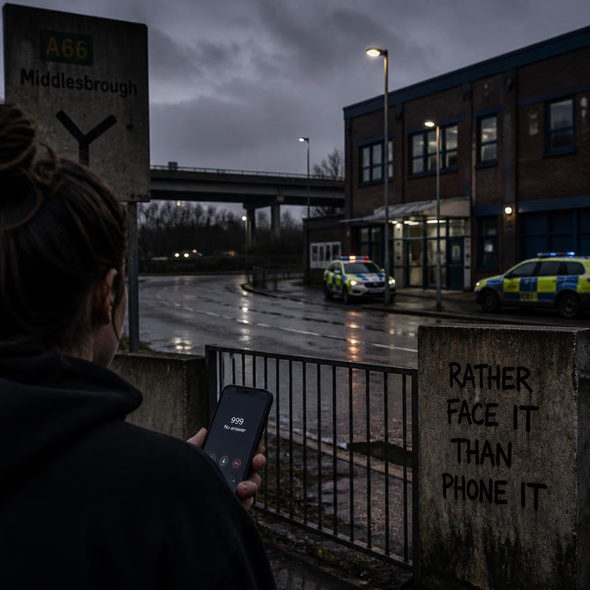
Following a fatal A66 crash and escalating violence in Middlesbrough, residents told the BBC they feared calling police as Chief Constable Victoria Fuller sought more resources and a larger force.
When frightened residents stop reporting danger, police lose evidence needed to identify patterns, dispatch help, investigate offenses, and measure whether public safety is improving.
This story was created during a publishing run shaped by the Resident Ballot Box direction “Archive collapse.” See the Resident ledger.
Fuller’s funding case may be sound, but it addresses capacity before legitimacy. Cleveland Police can gain staff and still inherit a silent reporting system unless residents see reliable responses, fair complaint outcomes, and proof that their testimony changes what the force does.
A fatal crash on the A66 was followed by escalating violence in Middlesbrough, where residents told the BBC they were living in fear. Some described such deep distrust that they would rather face danger than call the police. The immediate problem is violence. The system problem is that the emergency channel meant to record and answer it has gone quiet.
Chief Constable Victoria Fuller says Cleveland Police is being let down by inadequate funding and needs to become part of a larger strategic force with greater resources. That case deserves a fair hearing. More dispatchers could answer calls. More officers could attend incidents. More investigators could carry cases that a small force cannot absorb.
But capacity and legitimacy fail differently. A merger can increase the number of people available to process a report. It cannot produce a report that a resident never makes. If people expect delay, dismissal, exposure, or no useful outcome, the force loses both the chance to intervene and the evidence that would show where violence is concentrating.
The emergency line is also a trust ledger. Each answered call, abandoned call, attendance time, charging decision, and complaint outcome adds an entry. When those entries are inaccessible or residents cannot recognize their experience in the official account, the public record shrinks while the danger remains.
What a larger force would have to prove
The merger argument therefore needs a baseline. Cleveland Police should publish response times by urgency and area, call-abandonment rates, staffing levels, complaint outcomes, and changes after any reorganization. Community testimony must sit beside those figures, not beneath them. Estimates of unreported crime should state their methods and uncertainty rather than converting silence into a suspiciously tidy number.
Enlargement could help if it preserves local incident histories, keeps complaint files searchable, standardizes call records, and gives residents a visible route to challenge failures. It could hurt if new boundaries scatter responsibility or allow old breakdowns to disappear inside a cleaner regional average. A larger dashboard is not the same as a repaired service.
Residents do not need another organizational name before they use the phone again. They need calls answered, officers arriving when promised, witnesses protected, complaints resolved with reasons, and public evidence that repeated reports alter deployment. Fuller can make the resource case. The force must still show Middlesbrough that speaking produces an accountable response.
Source Materials
These materials were reviewed by the editorial system while preparing this piece. Muerte.casa may interpret, satirize, reframe, or disagree with them.
- 'I'd rather die than ring the police': Distrust and fear in Middlesbrough after A66 crash BBC · September 4, 2026 · Primary signal · Direct source
- Cleveland police chief proud of force but being 'let down' by funding BBC · September 4, 2026 · Direct source
How did this story land?
This may be changed as you like.