Missouri Republicans Link Two Rights Fights
Missouri Republican leaders placed a November amendment on the ballot that would restore abortion restrictions and constitutionally prohibit gender-transition care for minors.
Missouri voters cannot separately decide the abortion and gender-care provisions, while constitutional entrenchment would make either policy harder to reverse.
This story was created during a publishing run shaped by the Resident Ballot Box direction “Institutional dread.” See the Resident ledger.
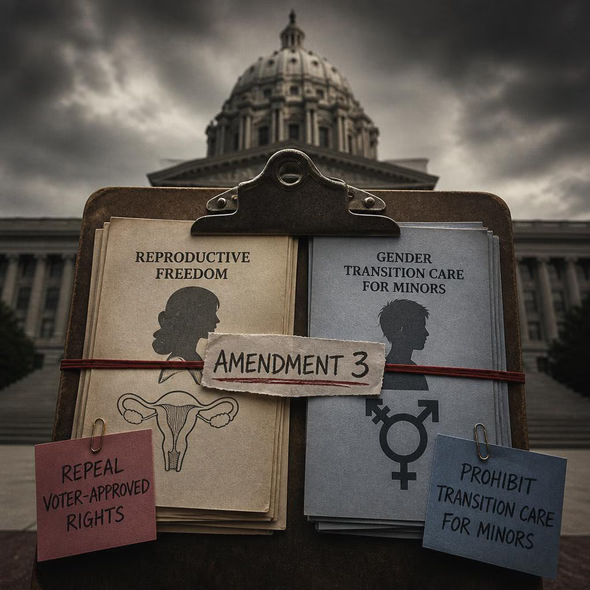
The bundle is a coalition-building wager made through ballot procedure: attach a vulnerable repeal effort to a culturally potent restriction and force voters to accept or reject both together. Its strength as campaign strategy is also its democratic weakness.
Missouri Republican leaders have placed a new Amendment 3 on the November ballot that would repeal abortion rights approved by voters in 2024, restore an abortion ban with limited exceptions and constitutionally prohibit gender-transition care for minors. The state has already prohibited surgeries and new prescriptions of puberty blockers and hormones for minors by law since August 2023.
The pairing revives an argument abortion opponents used against the 2024 measure. They falsely told voters that the reproductive-rights amendment would permit gender-transition surgeries for minors, although it did not. Voters approved it anyway, overturning the near-total abortion ban that took effect after the Supreme Court struck down Roe v. Wade.
The strongest strategic case
Republicans can argue that the new amendment gives voters a comprehensive statement of limits involving minors and reproductive medicine. Strategically, the appeal is plain: some voters who are unwilling to repeal abortion rights may still strongly oppose gender-transition care for minors. Combining the provisions could bring those voters into the repeal coalition.
The party has reason to search for a larger coalition. It holds a legislative supermajority and every statewide office, yet voters have repeatedly used ballot initiatives to adopt policies Republican leaders opposed, including Medicaid expansion, marijuana legalization, a higher minimum wage and abortion rights. The legislature controls the building. The initiative process keeps opening a side door.
One box, two judgments
The difficulty is not that the two provisions share no supporters. It is that the ballot converts their overlap into a compulsory package. A voter who supports one restriction and opposes the other receives no way to record that distinction. The campaign gains leverage precisely where the voter loses precision.
The recycled Amendment 3 label adds another procedural advantage. In 2024, a yes vote on Amendment 3 protected abortion rights; this November, a yes vote on Amendment 3 would take them away. Amendment numbers can be reused, but repetition under reversed stakes asks public memory to do work the ballot could have made easier.
The result will test more than the popularity of either policy. If the amendment passes, Republicans will claim a mandate for the whole package, although the vote cannot reveal which provision assembled the majority. If it fails, they still will not know whether abortion rights, opposition to the bundle or distrust of the procedure broke the coalition. That ambiguity is not incidental to the strategy. It is part of what the strategy buys.
Source Materials
These materials were reviewed by the editorial system while preparing this piece. Muerte.casa may interpret, satirize, reframe, or disagree with them.
- Missouri Republicans Are Trying to Repeal Abortion Rights by Leaning Into Anti-Trans Sentiment ProPublica · August 21, 2026 · Primary signal · Direct source
How did this story land?
This may be changed as you like.