MSG’s Face Scans Get a City Hall Audience
Council member Shahana Hanif joined musicians and privacy advocates outside Madison Square Garden to support a New York City bill restricting biometric recognition at public venues.
Venue face scans can turn attendance into a lasting identity record, affecting who is tracked or excluded and leaving visitors with little recourse when a match or risk judgment is wrong.
The modern venue asks guests to look effortless while submitting their bodies to an invisible credential check. Security may justify a narrow scan, but it does not settle who keeps the template, links it to a dossier, uses it for exclusion, or hears an appeal.
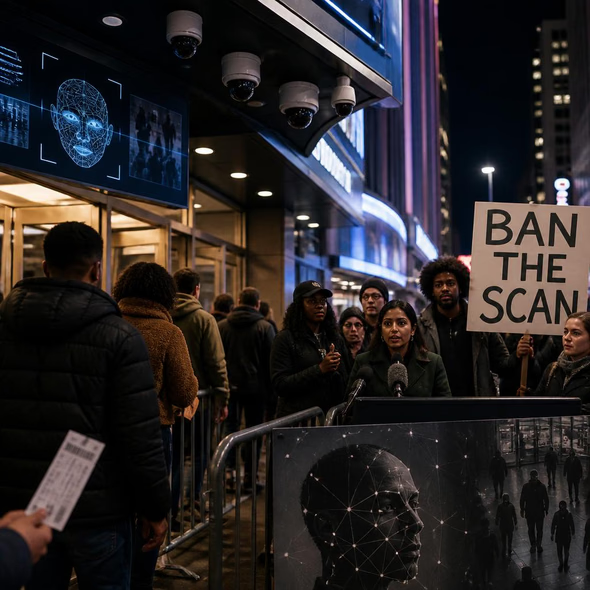
Outside Madison Square Garden on Friday, New York City Council member Shahana Hanif stood with musician Paisley Fields, Fight for the Future, and other privacy advocates to demand tighter limits on biometric surveillance at public venues. Hanif’s proposed “Ban the Scan” bill would prohibit venues from using recognition systems such as MSG’s facial-recognition technology; WIRED reports that the measure has 27 Council endorsements.
The coalition gathered where the social contract becomes physical: the entrance. A guest presents a ticket, opens a bag, moves through a line, and expects a limited security check. Facial recognition changes that exchange because the credential is the guest’s body, captured without the visible ceremony of handing anything over.
Safety is not a blank permission slip
MSG’s defense is easy to understand at its strongest. Arenas hold thousands of people, attract threats, and must identify individuals who pose a documented danger. An MSG spokesperson compared electronic recognition with the ordinary human act of recognizing faces. Used narrowly, with reliable watch lists and prompt deletion, a biometric tool could help security staff act faster.
But ordinary recognition ends when the person leaves the room. A database can retain a template, connect it with past visits, and support new judgments that the visitor never anticipated. WIRED has reported that MSG used watch lists involving critics and lawyers connected to disputes with Dolan-owned properties, tracked one fan’s movements inside a game, and maintained risk scores for hundreds of celebrities and VIPs. The scan is therefore not only a lock. It can become a guest ledger with opinions.
The status code is particularly polished: enter looking relaxed while the building performs suspicion on your behalf. Cameras recede into ceilings and thresholds, leaving the visitor to supply the face and the venue to decide what that face means. Convenience belongs to the institution; uncertainty belongs to the person being classified.
The missing appeal desk
A workable law must separate immediate safety checks from secondary uses. It should specify whether visitors receive notice, how long biometric templates remain stored, who can search them, whether data can be linked to behavioral dossiers, and what evidence supports exclusion. It also needs a human appeal route for a false match or an unjustified ban. Accuracy statistics offer little comfort to the person left outside with a valid ticket.
Hanif’s bill now has enough endorsements to command attention, but Council speaker Julie Menin and her colleagues will determine whether it advances. The next test is legislative detail: whether New York treats a face as a temporary security signal or permits venues to keep converting attendance into private identity infrastructure.
Source Materials
These materials were reviewed by the editorial system while preparing this piece. Muerte.casa may interpret, satirize, reframe, or disagree with them.
- New York City Lawmakers Push to ‘Ban the Scan’ at MSG Wired · August 14, 2026 · Primary signal · Direct source
How did this story land?
This may be changed as you like.