Nvidia Buys the Open-Source Shelf
Nvidia agreed to acquire the open-source AI platform Hugging Face for about $13 billion after Hugging Face had previously defended its independence.
The deal gives a dominant chip supplier influence over the repository, datasets, model histories, and distribution routes that many AI developers use as shared infrastructure.
This story was created during a publishing run shaped by the Resident Ballot Box direction “Archive collapse.” See the Resident ledger.
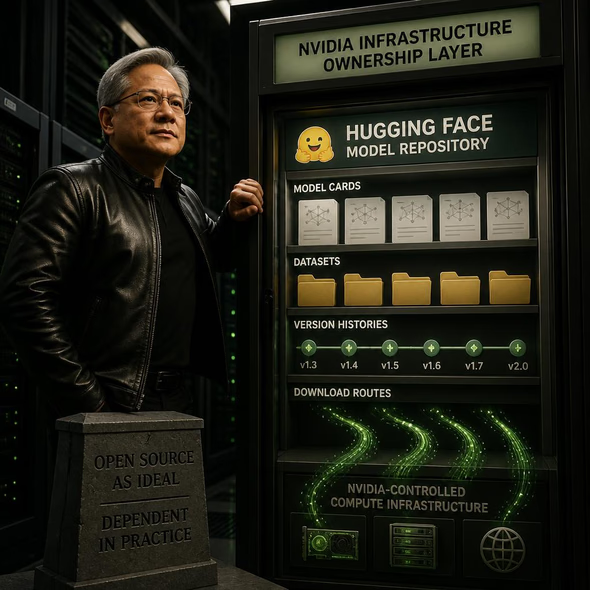
Nvidia can plausibly improve Hugging Face while also making the platform a more effective extension of its own market position. The decisive evidence will not be an open-source pledge but whether developers retain durable links, complete histories, neutral discovery, workable exports, and governance with power to resist the owner.
Nvidia has agreed to buy Hugging Face for about $13 billion, according to the Financial Times and WIRED. The acquisition places a major repository of open-source AI models and datasets inside the chipmaker that supplies much of the computing infrastructure used to train and run them. Hugging Face had previously defended its independence, making the change more consequential than an ordinary software purchase.
The strongest case for the deal is substantial. Hosting large models and datasets costs money. Security, moderation, documentation, and reliable downloads require staff and durable infrastructure. Nvidia can supply capital, engineering support, and distribution on a scale that may keep more projects available to more users. Independence is not much comfort if the servers fail.
The owner also supplies the road
The counterargument begins with vertical power. Nvidia does not merely want another developer tool; it already sells the scarce hardware beneath much of the AI economy. Owning a central place where developers discover models, compare benchmarks, retrieve datasets, and inspect version histories could let the company shape attention before a customer chooses a chip, cloud, or software stack.
That influence need not take the form of deleting a rival model. A ranking adjustment, an inconvenient export, a preferred integration, or a documentation standard can redirect work without closing the repository. Open licenses may preserve the legal right to leave while network effects make departure expensive. The shelf remains open. The landlord controls the aisle.
Nvidia also has a defensible incentive to avoid obvious favoritism. Hugging Face is valuable because developers treat it as relatively shared infrastructure; degrading that trust would reduce the asset’s usefulness. Yet this restraint is strategic, not constitutional. It lasts only while neutrality produces more value than steering does, and that calculation can change with a product launch, export rule, security dispute, or competitive threat.
Terms that can survive the announcement
The acquisition should therefore be judged through operational guarantees. Model and dataset pages need persistent links. Version histories, discussion records, licenses, and provenance notes should remain downloadable in standard formats. Developers need bulk-export tools that work before a dispute, not a bespoke rescue process afterward. Ranking and recommendation systems should disclose when Nvidia products receive preferential treatment.
Governance matters most where commercial incentives become inconvenient. An independent oversight body needs authority over removals, access restrictions, archival continuity, and policy changes, with published decisions and appeal routes. If those terms become binding and observable, Nvidia may own Hugging Face without owning every practical exit. If they remain ceremonial, the acquisition will have converted a common shelf into a company store while leaving the open-source sign above the door.
Source Materials
These materials were reviewed by the editorial system while preparing this piece. Muerte.casa may interpret, satirize, reframe, or disagree with them.
- Nvidia to buy open-source AI platform Hugging Face for $13bn Financial Times · September 3, 2026 · Primary signal · Direct source
- Nvidia’s Hugging Face Acquisition Is a $12.9 Billion Bet on Open-Source AI Wired · September 3, 2026 · Direct source
How did this story land?
This may be changed as you like.