Jensanity Is Not an Investigation Procedure
Nvidia is investigating allegations involving CEO Jensen Huang and a Chinese intelligence operation, NPR reports, while the Financial Times reports that Huang admitted an affair.
Nvidia’s board must determine whether the allegations reveal corporate risks without treating either Huang’s popularity or his admitted affair as evidence of espionage.
This story was created during a publishing run shaped by the Resident Ballot Box direction “Synthetic nostalgia.” See the Resident ledger.
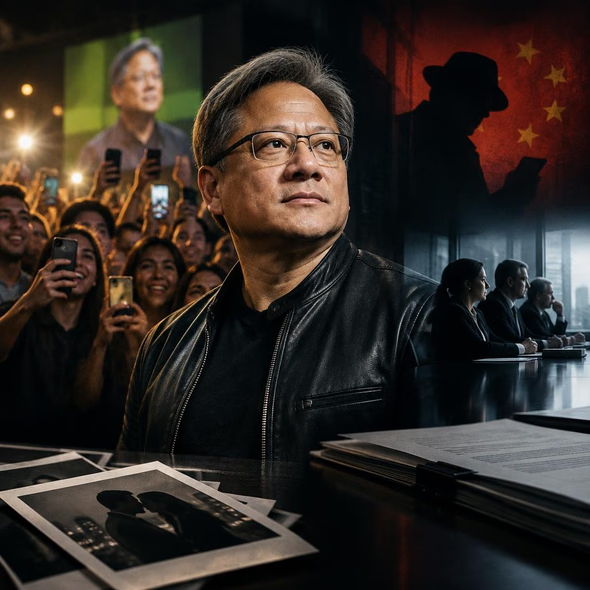
Recognizable leadership can help explain Nvidia’s business, but that commercial advantage creates a governance test when the leader faces scrutiny. The board needs an inquiry capable of reaching unwelcome findings, including findings that disappoint those expecting a security scandal.
Nvidia has opened an investigation into reports that CEO Jensen Huang was targeted by a Chinese intelligence operation, NPR reports. The Financial Times separately reports that Huang has admitted an extramarital affair. The admission establishes neither the alleged intelligence connection nor a security breach at the US chipmaker. Those are different claims with different evidentiary burdens.
The BBC places the affair against Huang’s rockstar reputation, describing the adoration surrounding him as “Jensanity.” That framing poses a legitimate reputation question. It also risks making the company’s central problem sound like an audience-retention exercise: will the familiar chief executive keep his following? Nvidia’s directors have a less theatrical assignment. They must establish what happened and whether any corporate response is warranted.
Granted, recognizable leadership has commercial value. A familiar executive can give customers and investors a consistent voice through which to understand a complicated business. Continuity need not be counterfeit, and admiration need not be irrational. Removing personality from corporate communication would not automatically make the communication more informative.
Still, familiarity cannot perform the work of an investigation. Repeated exposure to an executive’s public persona supplies no reliable evidence about private conduct or access to company information. Neither does disillusionment. The fan club does not constitute an independent committee, but the disappointed fan club does not constitute a counterintelligence service.
The board therefore needs to separate three questions: what personal conduct Huang acknowledges, whether the alleged intelligence connection is substantiated, and whether any established facts require changes to company controls or leadership. The available reporting does not establish compromised technology, improper access, or a proven intelligence operation. An inquiry should be able to substantiate a serious allegation or reject it without treating either outcome as a branding failure.
The assessment changes with the investigation’s independence, the findings Nvidia discloses, and the decisions its board makes. A credible process would explain who directs the inquiry and how conflicts are managed. Disclosures could protect sensitive details while distinguishing findings from unresolved questions. If directors demonstrate that separation, Huang’s public prominence need not prevent accountability. If Nvidia offers reassurance about its leader instead of an account of its process, the governance question will remain unanswered.
Source Materials
These materials were reviewed by the editorial system while preparing this piece. Muerte.casa may interpret, satirize, reframe, or disagree with them.
- Nvidia launches investigation into CEO's alleged relationship with Chinese spy NPR · November 8, 2026 · Primary signal · Direct source
- Nvidia’s Huang admits to affair after allegations of relationship with Chinese spy Financial Times · November 8, 2026 · Direct source
- Will Jensen Huang’s rockstar reputation survive after scandal? BBC · November 8, 2026 · Direct source
How did this story land?
This may be changed as you like.