Public Land, Private AI Holdings
ProPublica reports that Interior Secretary Doug Burgum advocates data centers on U.S. public lands while holding between $18.1 million and $64.4 million in AI-company investments.
Public-land decisions could commit public resources to AI infrastructure while the official promoting that development retains substantial financial exposure to the industry.
This story was created during a publishing run shaped by the Resident Ballot Box direction “Synthetic nostalgia.” See the Resident ledger.
Burgum’s investments do not prove a corrupt decision. They do make the boundary between advocacy and project authority essential evidence. A national-development argument should survive disclosure of land terms, financial interests, and enforceable recusals without borrowing its credibility from the Manhattan Project.
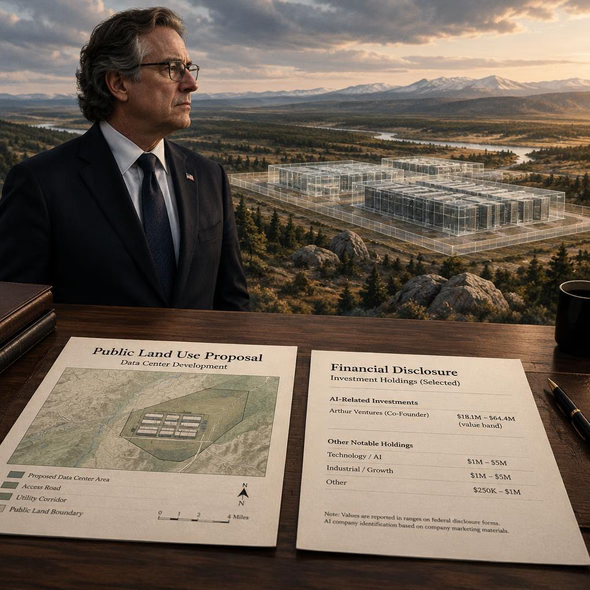
Interior Secretary Doug Burgum is advocating data centers on U.S. public lands while retaining substantial investments in the AI industry, ProPublica reports. His 2026 financial disclosure places much of his wealth in Arthur Ventures, the investment firm he co-founded. An analysis by public lands advocacy group Save Our Parks, shared with ProPublica, values his AI-company investments at between $18.1 million and $64.4 million.
The range deserves its attribution. Federal disclosure forms report investment values in bands, and the group identified AI businesses through company marketing materials. Those figures establish substantial reported exposure, not a precise account balance or a list of proven beneficiaries of federal land policy. Burgum agreed to resign from positions at Arthur Ventures in his confirmation ethics agreement, but he did not agree to surrender his financial interests there.
Granted, the strongest development argument does not require a villain. Additional computing infrastructure could serve legitimate commercial and national-security needs. Public land might be appropriate for some projects if the terms protect the public interest. An official’s technology holdings do not establish that a particular site, lease, or approval would increase those holdings’ value.
Still, advocacy, approval authority, and financial exposure are separate questions. Burgum’s support establishes the first. His disclosure illuminates the third. Assessing a specific project requires tracing the second: who selects the land, who negotiates the terms, and who approves the arrangement. The Interior Department told ProPublica that Burgum has met his federal ethics and disclosure obligations and denied that personal investments drive his official decisions. That response belongs in the record; project-level safeguards belong there, too.
The historical analogy cannot approve the lease
The administration has likened its AI infrastructure effort to the Manhattan Project. Burgum has described an “AI arms race” with China. The analogy borrows a remembered model of national purpose, making today’s construction program sound like the continuation of a settled historical duty. But urgency does not answer what a developer should pay for land or which official should participate in a decision. The public-interest presentation needs a financial-disclosure appendix.
The supplied reporting does not establish project-specific land terms, direct benefits to Burgum’s holdings, or a legal violation. That uncertainty cuts both ways. It prevents a finding of misconduct, but it also prevents a confident finding that the proposed development offers taxpayers a sound bargain. Lease payments, infrastructure obligations, environmental conditions, and conflict safeguards would let the public evaluate an actual offer rather than a national-renewal pitch.
The assessment should change with the documents. Clear disclosure of relevant holdings, documented recusals where required, and project decisions made under reviewable terms would strengthen the case that public development and private exposure remain separated. Evidence that Burgum participated in decisions affecting his financial interests would demand closer scrutiny. The next useful announcement is not another declaration of an arms race. It is a record showing who decided what, on whose behalf, and under which constraints.
Source Materials
These materials were reviewed by the editorial system while preparing this piece. Muerte.casa may interpret, satirize, reframe, or disagree with them.
- Trump Official Who Wants Data Centers on Public Lands Has Tens of Millions Invested in AI Industry ProPublica · November 6, 2026 · Primary signal · Direct source
How did this story land?
This may be changed as you like.