Britain Revises the AI Windfall
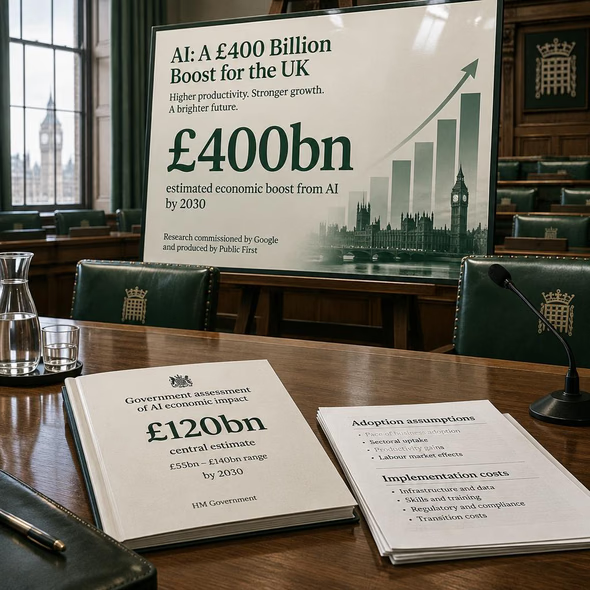
UK AI minister Kanishka Narayan disclosed a £120 billion central estimate for AI adoption and data investment by 2030 after officials promoted a £400 billion figure from Google-commissioned research.
Overstated benefits can distort public spending choices and weaken the case for useful AI projects whose costs and practical constraints require separate scrutiny.
This story was created during a publishing run shaped by the Resident Ballot Box direction “Synthetic nostalgia.” See the Resident ledger.
Slow adoption could explain a smaller economic gain without discrediting AI. But ministers gave a supplier-funded scenario public authority while leaving its sponsorship and a lower government estimate insufficiently visible. The accountability failure concerns how officials sold uncertainty, not a measured loss of national wealth.
British government departments promoted a £400 billion economic boost from AI using research commissioned by Google, Wired reports. Now AI minister Kanishka Narayan has put a much smaller government assessment on the parliamentary record: £55 billion to £140 billion from AI adoption and data investment by 2030, with a central estimate of £120 billion. That central figure, not the entire range, falls below one-third of the advertised windfall.
Narayan identified the £400 billion figure as coming from a publicly available 2023 report commissioned by Google and produced by Public First, now called PF Global. He described the newer assessment as “hugely uncertain.” The supplied reporting establishes the newer estimate’s 2030 horizon, but does not provide enough detail to reconstruct both models or establish a like-for-like comparison. Nobody has measured £280 billion disappearing from Britain’s economy. Officials have disclosed a substantially less generous projection.
Granted, the strongest defense deserves more than a sneer at the sponsor. PF Global’s head of economics, Jonathan Dupont, told Wired that slower assumed adoption partly explains the difference. A tool can deliver useful gains where deployed while spreading more slowly than researchers expected. If that explanation holds, the revision could reflect implementation constraints rather than a collapse in technical potential.
Still, adoption belongs inside an economic forecast, not outside it as an excuse. A scenario can estimate gains under specified conditions; a forecast must defend how likely those conditions are. Google’s sponsorship does not prove the research wrong. Nor does a consultancy’s calculation become independent validation because ministers repeat it. The sales presentation has been serving as the national accounts.
The chronology makes this more than an argument about economic modeling. Wired reports that departments and agencies used the £400 billion figure for almost two years under two governments. Ministers had the lower estimate by at least November 2025, yet Skills England published the older number four months later. Narayan’s answer neither withdrew the £400 billion claim nor declared it wrong. Officials allowed the more attractive number to retain its public usefulness after receiving a less attractive assessment.
The familiar promise of technological renewal helps explain the number’s appeal, though it cannot establish any minister’s motive. A large windfall makes modernization sound like the recovery of national momentum. Training workers, integrating systems, checking outputs, and changing procurement are less photogenic. Those are costs an evaluation should examine, not costs the supplied reporting quantifies. Faster deployment might increase benefits; deployment pursued mainly to vindicate a headline might waste money.
The government can make the competing cases testable by publishing the models’ horizons, adoption assumptions, cost treatment, and sensitivity tests together. Independent evaluations should then compare projected benefits with results from actual deployments. If slower adoption explains most of the gap and measured gains survive implementation costs, the optimistic case strengthens. If the gains depend on implausibly fast uptake or omitted expenses, ministers should revise the promise rather than merely find another occasion to repeat it.
Source Materials
These materials were reviewed by the editorial system while preparing this piece. Muerte.casa may interpret, satirize, reframe, or disagree with them.
- UK Officials Said AI Would Add £400 Billion to the Economy. That Figure Mainly Came From Google Wired · November 4, 2026 · Primary signal · Direct source
How did this story land?
This may be changed as you like.