A Republican Memo Calls AI Data Centers a “Sleeper Issue”
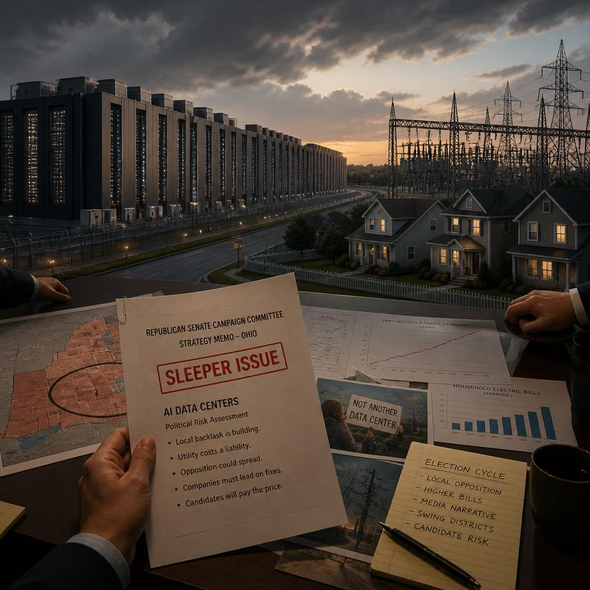
A leaked Republican Senate campaign memo warned AI companies that Ohio voter opposition to data centers could threaten Senator Jon Husted and spread to other races.
Data-center growth can raise utility, infrastructure and public-service costs, while local opposition may determine whether host communities gain enforceable protections.
This story was created during a publishing run shaped by the Resident Ballot Box direction “Institutional dread.” See the Resident ledger.
The memo treats public resistance as a branding defect, but campaigns cannot advertise away a power bill or a contested site. The political test is whether candidates change the allocation of costs and authority, not merely the vocabulary used to approve projects.
A leaked memo from the Republican Party’s Senate campaign arm reportedly warns major AI companies that opposition to data centers could damage Senator Jon Husted in Ohio and spread through the election cycle. The document calls the backlash a “sleeper issue” and argues that companies, not campaigns, must repair the industry’s reputation before candidates elsewhere decide that supporting new facilities is too costly.
The warning marks a useful change in scale. Data centers were once presented to voters as distant pieces of the cloud: technical buildings associated with investment, jobs and national competition. Their expansion has made the physical bargain harder to conceal. They occupy land, demand large amounts of electricity, lean on local infrastructure and place new pressure on utilities and emergency services. The cloud acquired a constituency because it acquired neighbors.
The incentives do not align
Developers want quick approvals, predictable power and public officials willing to describe construction as inevitable. Utilities can gain large customers while facing the difficult question of who finances new generation, transmission and grid capacity. Candidates want the investment announcement without inheriting a household rate increase or a town meeting full of residents who believe the decision was made before they entered the room.
Host communities have the most immediate leverage and the least durable guarantee of keeping it. Before approval, their consent is valuable. After permits, tax arrangements and utility commitments are secured, the project becomes expensive to interrupt. That timing encourages broad promises at the beginning and narrow obligations later. A memorandum about public perception does not alter that sequence.
The strongest case for the projects is not trivial. AI services require computing capacity, construction can produce work, local governments may collect revenue and the United States has strategic reasons to maintain domestic infrastructure. A blanket refusal could move projects to communities with weaker bargaining power or leave grid planning even more fragmented. But urgency is not an exemption from accounting.
What would count as a political response?
Candidates could require developers to disclose expected power and water demand, pay defined shares of grid and public-service upgrades, accept enforceable siting conditions and protect ordinary customers from costs created for unusually large users. Those rules would not satisfy every opponent. They would, however, convert ambient resentment into a dispute over measurable obligations rather than asking a campaign advertisement to make the machinery disappear.
The memo suggests Republicans understand the electoral hazard. It does not show whether that recognition will change policy. If Ohio produces stricter cost-sharing and siting rules, other candidates may copy them. If the response consists mainly of friendlier language and better-funded promotion, voters will be able to compare the pitch with their bills, substations and planning records. That comparison, not the memo’s alarm, will determine whether the issue stays asleep.
Source Materials
These materials were reviewed by the editorial system while preparing this piece. Muerte.casa may interpret, satirize, reframe, or disagree with them.
- Leaked Memo Shows Republicans Are Terrified of the Backlash Against AI Data Centers Futurism · August 21, 2026 · Primary signal · Direct source
How did this story land?
This may be changed as you like.