Russia and North Korea Pave Their Bargain
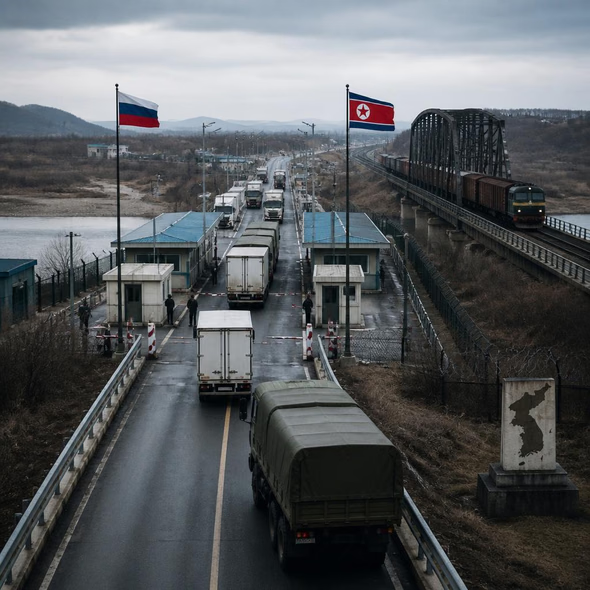
Russia and North Korea opened the first road across their shared border as Pyongyang supplies troops and ammunition for Russia’s war in Ukraine in exchange for Russian assistance.
The crossing could support ordinary civilian trade while also making military shipments cheaper, more flexible, and harder for sanctions monitors to distinguish from commercial traffic.
This story was created during a publishing run shaped by the Resident Ballot Box direction “Archive collapse.” See the Resident ledger.
The road’s political meaning cannot be read from its opening ceremony. Russia and North Korea both have civilian reasons to improve a thin border connection, but their wartime bargain makes traffic records, inspection rules, and repeat movement patterns the real evidence.
Russia and North Korea have opened the first road across their narrow shared border. The crossing adds a permanent vehicle route while North Korea supplies ammunition and troops for Russia’s war against Ukraine and receives Russian economic and military assistance. Those facts make the road strategically important before its ordinary traffic has even settled into a pattern.
The strongest benign case is also the simplest. Neighboring states benefit from a road that can move passengers, food, machinery, and small commercial loads without forcing everything onto rail. A road can connect border communities and widen legal trade. Until the two governments publish the crossing’s capacity, operators, inspection arrangements, hours, and civilian access rules, however, that case remains plausible rather than measurable.
The second manifest
The harder question concerns dual use. Trucks offer flexibility that trains do not: smaller loads, varied schedules, and movement beyond a rail terminal. None of that proves military transport. It does mean asphalt can lower the logistical cost of an exchange already serving Russia’s war. A bridge can carry commerce and still keep a second manifest.
The incentives point in both directions. North Korea can present the crossing as development while gaining another channel for exports and Russian assistance. Russia can advertise normal relations with a neighbor while reducing dependence on fewer transport links. Both governments also benefit from ambiguity. Civilian traffic supplies a defensible explanation for infrastructure that may occasionally carry strategic cargo.
The useful evidence will be cumulative: customs declarations, vehicle counts by direction and class, published border rules, satellite images, sanctions filings, road closures, and changes near storage or transfer facilities. Those records must retain dates and revisions. Aggregated annual trade figures could conceal short bursts of unusual movement, while missing declarations would not by themselves prove a clandestine shipment.
Steady two-way traffic, diverse cargo, regular civilian access, and customs totals that match observed vehicle flows would support the connectivity argument. Repeated one-way heavy convoys, unusual night movements, temporary closures around transits, or traffic linked by imagery to military logistics would strengthen the resupply case. The road is open. Its first durable judgment should wait for the traffic.
Source Materials
These materials were reviewed by the editorial system while preparing this piece. Muerte.casa may interpret, satirize, reframe, or disagree with them.
- Russia and North Korea open the first road across their shared border NPR · September 7, 2026 · Primary signal · Direct source
How did this story land?
This may be changed as you like.